Showing posts with label bisexual. Show all posts

Friday, September 22, 2017

Peanut Butter AND Chocolate Brownies: September Means Both

It's Bi Visibility Month!

Those of you who follow me in other places on the internet know I'm bisexual, so you get why I'm excited. It’s all too often that those of us who are bisexual are erased by the gender of our partners—or our lack of one. People assume being bi means that you’re constantly craving the company of two sets of genitals, instead of understanding that it means that we can find our perfect partner amongst people of more than one gender.


The bi pride flag is made of three colors. Blue, pink, and purple. The purple rests solidly in the middle as a visual metaphor for what it’s like to be bi. No matter the gender of the person I may one day choose to spend the rest of my life with, that will never change my sexuality. It’s like being a Reese’s Peanut Butter Cup. Not chocolate, not peanut butter, but BOTH.

So let’s talk about how to make some mouthwatering peanut butter brownies!

Ingredients:
Brownie Batter -
3 oz unsweetened chocolate, roughly chopped
⅓ cup unsalted butter (plus a little greasing the pan)
1 ¼ cups granulated sugar
2 large eggs
1 tsp vanilla extract
¼ tsp coarse sea salt
⅔ cup all-purpose flour
(Store bought is also fine if this sounds like too much work)

Peanut Butter Batter -
¾ cups peanut butter
⅔ cup granulated sugar
1 large egg
¼ tsp vanilla extract
A few pinches of salt

Before you begin, preheat your oven to 350 degrees F. You’ll want to dig out an 8’’ square baking pan as well, and line it with parchment paper and then coat that with nonstick cooking spray or butter.

Once you’re done with that, we can start in on the respective batters. To make the brownie batter, melt the chocolate and butter in a heatproof bowl over a gently simmering pot of water. Turn off the heat when they’re mostly melted, and stir them together until they’re fully melted and smooth. If you don’t have a heatproof bowl, you can melt the chocolate and butter in the microwave using thirty second bursts. Be careful not to microwave for too long, though, because you could burn your chocolate or cause it to separate.

Next, whisk in your sugar. Then your eggs (one at a time). Then your vanilla and salt. After your whisking is done, stir in your flour with a spoon or spatula.

The peanut butter batter is much simpler than the brownie. Just throw all the ingredients in a bowl and whisk/stir until completely combined. I find whisking works best when using smooth peanut butter, but can be tricky when using crunchy.

Once both batters are ready, spread a thin layer of brownie batter across the bottom of the pan. Then toss alternating spoonfuls down in rows to fill the pan. Use a butter knife to swirl the batters together in pretty wavy fashion. This works best for me if I think of drawing figure eights or infinity signs. Now the brownies are ready to go in the oven! Bake for thirty to thirty five minutes, and check with a toothpick to make sure the brownies are cooked all the way through.

There’s a very special book I want to talk about this month. I only just got my hands on a copy a few weeks ago at Rose City Comic Con in Portland, and the artist (Irene Koh) was sweet enough to even autograph it for me.


That’s right, you guessed it. The Legend of Korra: Turf Wars Part 1!


“But what’s so exciting about this book?”, those of you who didn’t guess what I was talking about might ask. What’s exciting about this book is that it’s a fantasy story about a young woman named Korra, who is tasked with keeping her world in balance. She is the Avatar, capable of manipulating all four elements and communing with spirits. And she just happens to be in a relationship with Asami Sato—another woman, who also previously dated Korra’s ex-boyfriend.

That’s right. You heard me. There’s an A-list title out there that features two bisexually behaving women in a relationship with each other THAT ISN’T FOCUSED SOLELY ON THEIR RELATIONSHIP.

That doesn’t mean the relationship between them isn’t a large part of the story, though. And what’s even more exciting about it is how realistically Korra and Asami’s love story is handled. While the previous iteration of The Legend of Korra that ran as a cartoon on Nickelodeon refused to even acknowledge the same-sex relationship Korra and Asami canonically started during the events of the cartoon, the Turf Wars Part 1 gives Korra and Asami room to talk about what it was like when they were still questioning their feelings for each other.


These two pages made me cry because they were so spot on about what it’s like when you first discover you might have feelings for someone of the same sex as you. You’re scared they might push you away, you’re not sure what you’re feeling is real—and yet ultimately you come to the conclusion that you want to take the leap.

The Legend of Korra: Turf Wars Part 1 doesn’t fall prey to the trope of letting Korra and Asami exist as the only queer characters in a non-queer vacuum, either. Almost as soon as Korra and Asami return to Republic City from their vacation, one of the previous Avatar’s children Kya notices their relationship—in part because she’s in a same-sex relationship herself.


The book then goes even further to retcon how same-sex relations were handled by the different cultures in the entire Avatar franchises continuity.


Normalizing same-sex relationships, giving them a place in the historical narrative even when they weren’t accepted… These are new, exciting things for an A-list title to do. Korra and Asami meet with different reactions as they navigate their new relationship. Korra’s parents are worried she and Asami will be mistreated if they don’t keep it private. Due to their reaction, Korra and Asami are nervous about telling their friends, and their mutual ex/friend, Mako. The truth comes out after a battle when Korra rushed to the side of a possibly wounded Asami.


Everyone reacts well, except for Mako. But Mako doesn’t react poorly! What’s exciting about Mako’s reaction is that it hints at further discussion about how friends can support their friends who come out. Sometimes people feel that someone else’s sexual preference reflects on them. In particular, sometimes men who have ex-girlfriends that come out as bisexual or gay will feel emasculated and respond poorly, taking their misplaced hurt out on others. Mako isn’t the sort of character to take those feelings out on Korra and Asami—but he is the sort of character that might be confused about his feelings after hearing that two of his exes got together. Should something come of that and a conversation is had between Mako, Korra, and Asami, it will serve as a positive example for how other people in Mako’s position can respond.

All in all, The Legend of Korra: Turf Wars Part 1 is exactly the sort of representation I’ve been craving all these years. It couldn’t have come at a better time—and we finally got that kiss Nickelodeon refused to give us at the end of Season 4.

Friday, June 24, 2016

Lemon Bars: When Life Gives You More Lemons (Like Shootings During Pride Month)

So, Orlando happened. And I’m furious. And that’s really all we’re going to say about that here. I wrote a piece about it I’ll probably be submitting to Bi Women Quarterly’s fall issue, but feel free to read it in my Google Docs now if you need to spend a moment on that. When you’re ready, we’re going to talk about how to get rid of that sour taste in our mouths—by replacing it with a better sour taste.

Lemon bars are one of my all time favorite desserts. Not only do they have that delightful sweet-sour balance we call “tart,” but they’re this cheerful sunshine yellow that is impossible to keep from smiling over. The dusting of sugar on top is just the icing on the cake (pun intended, thank you).


Crust Ingredients:
½ pound unsalted butter at room temperature
½ cup granulated sugar
2 cups flour
⅛ teaspoon kosher salt

Filling Ingredients:
6 large eggs at room temperature
3 cups granulated sugar
2 tablespoons grated lemon zest (this will take between 4 and 6 lemons)
1 cup freshly squeezed lemon juice
1 cup flour
Confectioners’ sugar, for dusting on top

To begin with, you’ll want to preheat your oven to 350 degrees F. After that, gather your crust ingredients. You’ll want to cream together the butter and the sugar until they’re light. You can do this by hand, or in the mixer with your paddle attachment (if you have fancy toys like that). Next, combine the flour and salt and then add them to your butter and sugar. Doing this slowly will help ensure that everything really gets mixed together instead of just combining in lumpy, flour bombs. Don’t be afraid to get your hands dirty if you need to. This is your dough mixture, so you’ll be able to rub it off your hands and back into the bowl fairly easily. Adding a little flour to your hands can also help keep them clean. You’ll want to flour your hands for the next step anyway, because once you’re satisfied with your dough you’ll press it by hand into a baking sheet. For the amount of dough you have, you’ll want a 9 by 13 inch baking sheet that has a height of two inches. You will want to make sure your pan has at least a 2 inch height, otherwise you risk your filling running over. Make sure you build up a ½-inch edge for your dough on all sides of the pan. Then, bake the crust for 15 to 20 minutes until it is very lightly browned.

While that’s baking, we can get started on our filling. All you’ll need to do for this is whisk together your eggs, sugar, lemon zest, lemon juice, and flour. The order in which the ingredients are added won’t affect the end result, so just throw it together however you see fit.

Once the crust has finished baking, go ahead and pull it out. You can let it cool if you’re worried about it retaining its shape, or you can pour your filling over your crust immediately. Either way, once you’ve added your filling to the baking pan, return it to the oven for another 30 to 35 minutes until the filling has set. You can check your filling by piercing it with any long, thin object. Toothpicks are fine. If the toothpick comes back mostly clean, you’re good to go.

Take the lemon bars out of the oven once set, and let them cool to room temperature. Now you’re ready for your confectioners sugar. You can sugar the whole top of your bars without cutting them, or you can cut them into squares or triangles and dust them after cutting them. I find that if you don’t care about presentation leaving the lemon bars uncut keeps them a little fresher, but you will mess up the sugar on top of them each time you cut one off. If this is a classy affair, cut them and then dust them. Either way, enjoy this much superior sour taste!

That said, there is this thing that’s happening in media that’s also been leaving a vaguely sour taste in my mouth. It boils down to the inclusion of queer characters in media that have no established queer identity. I was discussing this with a friend, because on the one hand not establishing a queer character’s sexual preference or gender identity allows more people from the queer community to relate to said character. However, it also is one of the leading contributors in erasure of certain demographics from the LGBTQIAP+ acronym. For example, you’ll notice that two weeks ago in my Ceviche post I at no point referred to any of the characters I discussed with a label for their sexual preference. Although Korra and Asami from Avatar: The Legend of Korra, and Alphys from Undertale all exhibit what read to me as bisexual tendencies (perhaps colored by my own bisexuality), there’s no way for me to know that bisexual is truly the identity they subscribe to. Maybe after dating Mako Asami discovered she was only into women. Maybe Korra, as the spirit-focused Avatar, has discovered she’s not really about the flesh unless she’s romantically attached to someone and considers herself demisexual. Maybe Alphys prefers pansexual to bi because it’s not so much that she likes people of two different genders but rather finds that gender doesn't matter to her when she’s falling in love. Even Undyne’s lack of partners aside from Alphys in Undertale doesn’t mean that I can automatically consider her a lesbian. Maybe one of them is intersex. Maybe one of them decides they don’t like intercourse and prefer to be asexual. Maybe one of them decides they’re not comfortable with the gender they were assigned at birth. Maybe one of them is questioning.

The problem is that no one knows. It allows for people in any of these situations to project and see themselves in these characters (which is awesome, because there are still so few healthy portrayals of these types of characters in our media), but it also means that viewers in these situations never truly see their real life struggles portrayed because of the lack of specificity in these characters’ identities and experiences.

That’s why this month we’re going to talk about media that does get more specific. May I present to you my favorite manga starring a male same-sex couple, Fake. When Randy "Ryo" Maclean, a half-Japanese cop, shows up as the new recruit at the New York 27th Precinct, he is immediately and unceremoniously partnered with the infamous precinct trouble magnet, the cocky and smooth-talking Dee Laytner. The seven-volume manga details their adventures as New York detectives. Hostage situations, juvenile delinquents, and more than enough bullets to keep them busy, Ryo and Dee end up delving into the underbelly of the city and their pasts, and their budding relationship.

Often Boys’ Love manga suffers from a lot of unfortunate tropes. Fake falls victim to fewer of them than most, and does a pretty damn good job of being a positive portrayal of queer characters for being a story from 1994 that comes from conservative Japan. To begin with, I’m not saying this manga doesn’t have it’s problematic moments. What I am saying is that it does a fantastic job of portraying two realistic men who have the hots for each other and live in a time that didn’t teach relationship best practices. But what is it that sets Fake above all the other Boys’ Love manga for me? Well, the fact that Dee is a bisexual man.

This isn’t just me inferring, either. This is Dee upfront coming out and telling everyone who makes the assumption that he’s gay because of his interest in his partner Ryo, including Ryo.


Again…


And again…


And again.


As a bisexual myself, I can assure you it’s no joke that bisexuals often have their sexuality assigned by the people around them by the partner or sexual interests they express in a moment. When I was with my first girlfriend, tons of my classmates kept asking me what it was like to be a lesbian. It gets exhausting having to always correct people—but it was majorly reassuring having to see Dee put up with the same struggle.

The manga also does a great job of showing Ryo questioning his sexuality. Dee is the only man he’s ever been interested in, and so it makes Ryo rather standoffish because he doesn’t want to think of himself as a homosexual.

He has some pretty extreme reactions when people assume he’s gay, like when he meets Dee’s adopted parent known as Mother to the children of the orphanage where Dee grew up.


But, after punching out another man that kisses him, Ryo tries to figure out why he thinks of it as “different” when he kisses Dee.


Seriously, questioning is a pretty difficult time, even when the answers seem to be pretty obvious to an outside observer like a friend or a reader.


The phrasing in the first panel also makes it very clear that Ryo’s interests in Dee far outrank the ones he’s had for women in the past. While this does seem to lean towards indicating Ryo is gay, it could also be an indicator that he is demi, bi, or pan and just never found the right woman to fall in love with. Thankfully, Ryo has some pretty great support from Mother, his FBI contact Diana, and an insightful witness protection case.


It’s left unclear how Ryo ends up choosing to identify, but what is made VERY clear in the text is that Ryo is questioning and seems to come to a conclusion for himself even if it isn’t shared with the readers.


The portrayal of questioning characters may seem like a cop-out (heh heh, get it? Because Ryo is a cop?) in matters of specificity, but I would argue it’s one of the most important types of characters to be specific about portraying. Why? Because every member of the queer community went through a questioning phase before deciding on their identity.

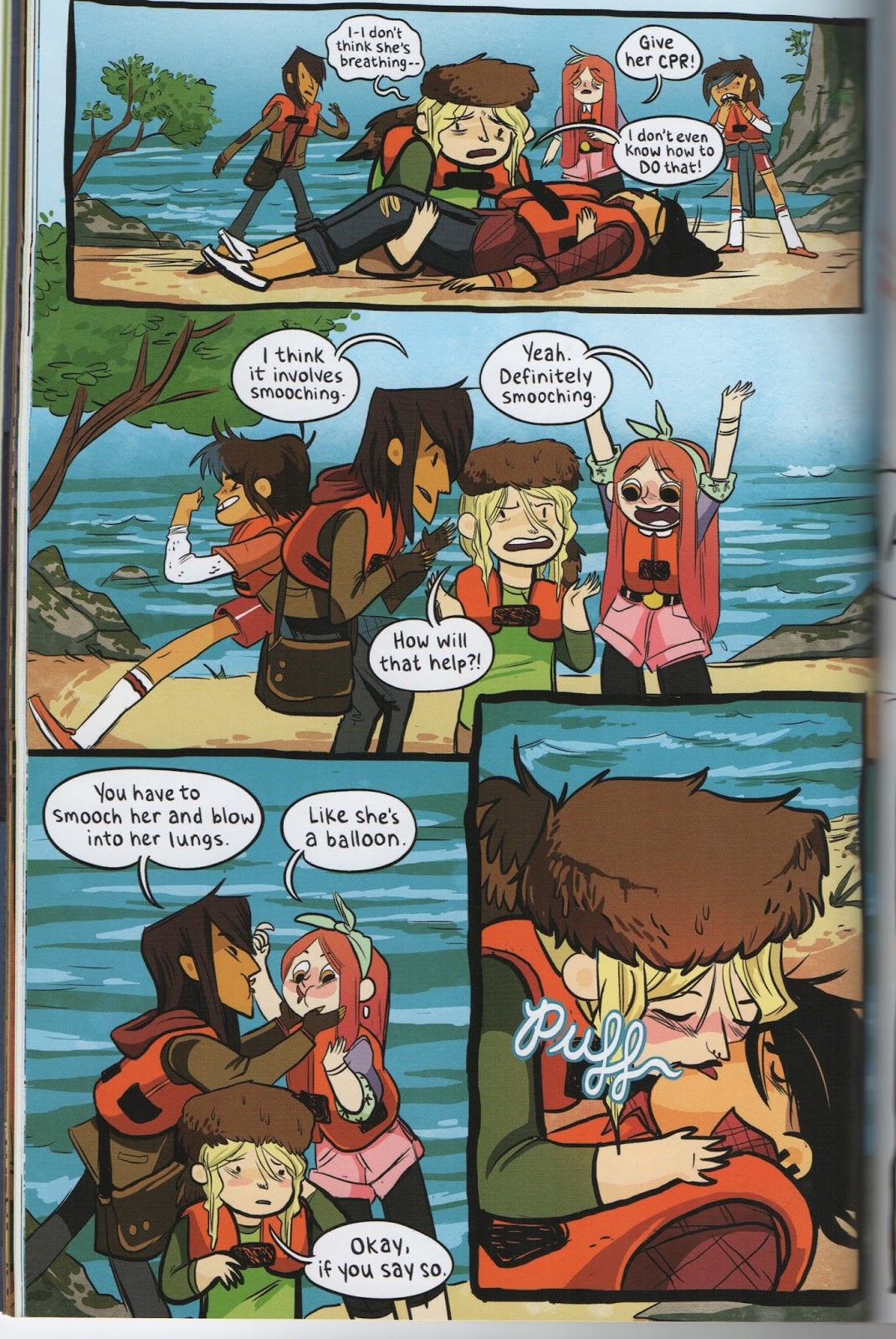
One comic series that is doing a fantastic job of portraying questioning characters is Lumberjanes. Molly and Mal are two of the five girl band that make up the leads of the Lumberjanes cast—and they’re totally adorable together. Their romance may be a bit in the background during the first two collected volumes—only really presenting itself when Molly tries to perform CPR on Mal after facing off on the river with a water dragon:


But their relationship takes center stage in the third collection, where even the plot mirrors their questioning of their own identities.

Sucked into a magical dimension, Molly and Mal have to decide if what they want (read as “getting back home” and as “a relationship with each other”) is something they’re willing to risk and be brave for.


For a couple of young girls, that’s a big, big step—and one that a lot of members of the queer community take at a similar age. The really awesome part is the support of the other Lumberjanes...


...and Molly’s and Mal’s conclusions.


Without portrayals of characters that can relate to the specific struggles of our daily lives, we are leaving out the experiences not only of our viewers, but of human beings in general. It’s time for the tropes to be broken and a whole new, human cast to emerge in storytelling—one that doesn’t tolerate the sort of hate that led to the tragedies of Orlando.

Orlando, this bisexual sister stands with you. And I swear that we’re gonna make this sour sweet.

Friday, June 10, 2016

Ceviche: IT'S PRIDE MONTH!!

It’s June. To me, this means two things: A) we’re finally getting some sunshine in Oregon, and B) it’s Pride Month!! And not just any Pride Month, either. If you haven’t heard about President Obama’s proclamation, go read it here. During last year’s Pride Month I was studying in Akita, Japan. I remember the Supreme Court’s decision regarding marriage equality passing while I was over there and being affected more than I thought I was going to be. As a bisexual woman, I wasn’t feeling the heat of not being able to marry a partner I loved yet. Knowing that I could left me more than a little breathless.

That was before this blog, so this year, we’re going to celebrate!

I chose ceviche for our recipe because not only is it a very attractive food with lots of different colors—almost rainbow-esque, some might say—but it’s the perfect sort of thing to serve at a great big, outdoor, summer gathering! Perhaps for your very own pride party, eh?


Ingredients: (it goes without saying all of these should be fresh)
1 small rock fish fillet
1 pound shrimp
5 limes
1 lemon
½ - ¾ tomato juice
1 large sweet onion
1 cucumber
1 tomato
1 avocado
3 jalapeño peppers
1 bunch radishes
2 cloves freshly minced garlic
¼ cup chopped cilantro
1 teaspoon salt
Tortilla chips (not actually included in the ceviche, but a handy tool for eating it!)

First, peel and devein your shrimp. Give them a rough chop if you like. Then, throw your shrimp and your fish into a bowl and juice your lemon and limes over them. Be sure that the seafood is completely covered in the juice. The idea behind ceviche is to cook the seafood with citric acid. If the seafood isn’t completely submerged, it won’t cook correctly. Cover your bowl and place it in the fridge for 30 minutes to cook. The shrimp should be opaque and slightly firm at the end. If at the end of 30 minutes you’re still concerned your seafood might be raw, throw it in a pan for a very short amount of time.

While the shrimp and fish are cooking, you’ll want to dice and combine your onion, fresh tomato, cucumber, avocado, and radishes. Toss in your tomato juice too. Once combined, toss and mix in the garlic, cilantro, and jalapeños to reach the desired level of spice. Be aware that your jalapeños will become stronger the longer they sit in the mixture, so if you plan to let your ceviche sit for a while you may want to hold off. I like my food spicy, so I mixed them all in and enjoyed the flavor.

Once your seafood is cooked and your other ingredients mixed, combine the two bowls together. You can leave the lemon and lime juice in if you like and even throw in some more tomato juice to play with the consistency of the ceviche.  Or you can strain most of it out if you prefer less liquid in your ceviche. Yvonne (yes, the same chef who made my birthday cheesecakes) and I left most of the citrus juice in. It was great day-of, but I would recommend straining it out before eating it again if you store it. I would also recommend eating this at room temperature. I found that if the mixture was too cold I couldn’t taste all of the ingredients as well.

Now, how does this relate to Pride Month, you ask? Aside from the beautiful coloration and apt weather conditions, I picked this dish because it takes time. More than anything, whenever I’ve seen media that wasn’t pitched as LGBT+ from the beginning, the media takes time to introduce the queer elements of their characters.

There are two bits of media I’d like to talk about in that respect, the first of which being Avatar: The Legend of Korra. The series is four seasons long, and in the first three seasons both Korra and her fourth season love interest Asami are presented as heterosexual women. They even date the same male firebender, Mako. Even in the first season, however, Asami and Korra are hardly rivals or unfriendly just because they’re interested in the same young man. Very early on in Asami and Mako’s relationship, before Korra has anything more to do with him than a crush, Asami takes Korra for a drive. This may seem fairly mundane—until you realize that Asami is the heir to a multi-million yuan (the Avatar universe version of currency) technological company. Aside from being a skilled mechanic, Asami is versed in the operation of all her company-to-be’s equipment. As the only non-elemental bender of the group, this is how Asami keeps up with her bender friends in the main story. So when Asami takes Korra for a drive, it’s one hell of a whirlwind, stunt driving scenario, and the two end up friends before the end of Asami’s introductory episode.


It’s unclear if series creators Bryan Konietzko and Michael Dante DeMartino meant for Korra and Asami to be romantically involved from the beginning, but regardless of original intent, it was refreshing to see two women interested in the same man not detesting each other over that. There’s an unhealthy trope I see a lot—both in real life and in media—of women viewing other women as competition when it comes to romantic inclinations. Korra and Asami’s avoidance of the trope seems rather apt now, since they become each other’s romantic interest in season four, but the initial avoidance of the trope was one of the things that kept me watching and clued into the fact that The Legend of Korra was going to be as good as its prequel series Avatar: The Last Airbender.

That said, it did take four seasons for Korra and Asami to end up together, and—due to Nickelodeon's archaic views on LGBT+ content—was fairly subtle. At the end of season three, Korra suffers a horrible injury that inhibits her abilities as the Avatar, wielder of all four elements and bridge between the human world and spirit world. She withdraws to her Water Tribe home in the south and corresponds with almost no one. Her only penpal? Asami. And just look at the amount of letters she’s written to Korra!


Korra recovers to an extent by the beginning of season four, but due to the conflicts of the story, Korra and Asami hardly have a moment together that isn’t fraught with plot-relevant tension. At the end of the season, a different, heterosexual couple gets married. Korra and Asami both attend the wedding, and slip off together. There, they have a conversation.

This type of conversation is one that I see many same-sex couples have. It’s one where viewers who do not expect to see a conversation between lovers see only a platonic bond, and viewers who expect to see romance, do. The two are emotional, affectionate, and physically touch each other. They agree to go on a trip together to the spirit realm. Just before entering the portal, they hold hands, turn to each other, and gaze into each other’s eyes with content smiles—mirroring the wedding pose from earlier in the episode.


Konietzko and DeMartino both verified that these choices were intentional and that even though they hadn’t been allowed to include a kiss between Korra and Asami—despite the overwhelming amount of heterosexual kisses in the show—Asami and Korra were indeed canonically in a relationship.

Dark Horse Comics has the rights for The Legend of Korra comics, and we all know the independent Northwest comics company has no issues with including diverse characters! I’m looking forward to seeing Asami and Korra’s relationship develop in the comics, and until that time, we have official art from Konietzko to tide us over.


The second piece of media I want to talk about is, once again, Undertale. Seriously, if you haven’t played it yet, even if you think you’re not a gamer, get yourself a Steam account and buy this baby. If you need convincing or background, check out my first two blog posts about Undertale here and here.

I attribute Undertale’s development as an indie game to be the reason that this game does so many things right. Korra and Asami were stunted due to some pretty unfair corporate calls, but Undertale creator Toby Fox didn’t have to adhere to anyone’s call except his. Due to his creative freedom and the support of his team and backers, Fox was able to include not just one but two same-sex couples in Undertale.

The first is stumbled upon in the course of the main storyline of all Neutral and Pacifist runs of the game. I believe in a Genocide run of the game, they have already fled before you arrive. The couple is a pair of guards tasked with evacuating an area due to a human wearing a striped shirt. They mistake you for a monster and try to escort you out of the area before realizing you’re the human they’re looking for and engaging you in combat.

The thing about combat in Undertale is that you really don’t want to kill anyone—which immediately puts using the “Fight” option in battle out of the question. Instead, you have to “Act.” Actions vary immensely from battle to battle, and if you don’t choose the correct actions from your action menu, the consequences can be severe. The best option is often to “Check” each monster and see what their description says. Often this can help lead to the correct course of action, especially when one is at a loss for what to do. Watch what you have to do in order to win the battle with the Royal Guards.


Think back to Korra and Asami’s fourth season conversation that could be read as platonic by viewers who weren’t expecting to listen to a conversation between lovers. This particular fight, I hear, has given some people a lot of trouble because they simply didn’t know what to do with it—because they weren’t expecting it to be a love confession between two male guards!

What’s important about this initial exposure to a same-sex relationship is that it changes the player’s expectations about situations, characters, and tropes in the game. While the player may have previously only been assuming that characters in the realm of Undertale were heterosexual, either due to the massive brainwashing of our media and culture or through some personal sense of bigotry. Now, they are either expecting to see more diversity amongst the characters or have quit playing in childish outrage.

This lays the stage for the main same-sex couple from Undertale: Undyne and Alphys. There are hints that Undyne and Alphys are interested in each other that the player can see during a Neutral or Pacifist run. The first is during their friendship encounter at Undyne’s house when Undyne is trying to civilly offer the player a drink without acting on her urge to immediately hunt any humans that enter the underground. The options you are given are sugar, soda, hot chocolate, and golden flower tea (obviously the correct option). Undyne won’t give the player anything but tea. However, her reaction when the player selects the soda is noteworthy.


If the player has been to Alphys’s lab, they know that Alphys has a penchant for junk food and soda. However, when I did my first run of Undertale, I completely missed this small hint to Undyne’s affections for Alphys BECAUSE I WASN’T EXPECTING IT!

The game gives you another chance to catch on, though. When taking Mettaton’s quiz in Alphys’s lab, his last question is “Who does Doctor Alphys have a crush on?” Being the hubristic thing I am, I went with option C) The Human. Here’s the thing, though: all of the answers are right! While Mettaton will accept The Human and Don’t Know as answers, because Alphys is obviously very interested in humans and the grand concept of someone unknown in an alternate universe where Alphys has found romantic attachment is completely possible (according to Doctor Alphys’s research). Of course, the best reactions come from options A and B, Undyne and Asgore respectively.


While these two moments in the Neutral and Pacifist runs are there, they can easily be missed. For example, not reading into Undyne’s blush and selecting one of the other three answers to Mettaton’s final quiz question would keep the player from ever noticing any of this! Fortunately, in the true Pacifist ending to the game, the player sees Alphys and Undyne confess their love to each other, and they receive a real happily ever after.


If you want to see the whole adorable story of how that happened, I suggest you hustle over to Steam and get to playing Undertale, my friend. I guarantee you will not be disappointed.

Happy Pride Month, everybody!