Showing posts with label Boys' Love. Show all posts

Friday, July 28, 2017

Miso Soup: But Not As You Know It

People travel, and people eat. When done in tandem, it becomes apparent that the way we’re used to eating something in one region of the world isn’t the way it’s eaten in other regions. America is a particularly interesting example, because it’s fairly easy to find food from all over the world here. Our diverse population is to thank for that. But when one travels to Japan and eats Japanese food, sometimes a thing we think we are familiar with confronts us with completely new flavors!

This was my experience with miso soup when I was studying in Akita—a city in Northern Japan that is considered to be fairly rural and spacious. The two kanji used in the name of the city reflect that, as they mean “Autumn rice.” As you can imagine, a lot of rice is produced in Akita. So are a lot of vegetables! So when I ate miso soup there, and found daikon radish and carrot in it instead of the “usual” tofu and seaweed, I was blown away. It grew on me, and now I find myself resenting that we only serve miso one way in the United States. Fortunately, miso soup is a fairly simple dish, and I was recently able to recreate the soup I ate in Akita two summers ago.

Ingredients:
1 small daikon radish
2 medium carrots
1 block soft tofu
½ cup white miso
9 cups of dashi

A quick preface: the ingredients list I’ve given above is for a main course miso, as in you’re planning on making it the main part of the meal. If that’s not the case and you’d prefer to serve this soup as a side dish, halve the recipe. There are also different types of miso out there! Miso soup is typically made with white miso as opposed to yellow or red miso. White miso is the least salty of the miso family. Yellow is more salty, and red is the saltiest! Be aware of this when picking out your miso and playing with the recipe. You can read more about different types of miso and their uses here. I’m sure you’re also wondering what dashi is. Dashi is a soup base commonly used in Japanese cooking. If you’re interested in making your dashi from scratch or making vegetarian dashi, here’s a handy guide. Otherwise, simply go to your local Japanese specialty store and grab some premade dashi packets. If you don’t have a specialty store near you, you can even order it online!

Now that you have all your ingredients and understand them to some degree, let’s get started. You’ll start by creating your dashi broth—either by boiling the ingredients you’re making it from scratch with in cheesecloth or by boiling one of the premade dashi packets you purchased. While you’re making your dashi, clean and cut the ends off your daikon radish and your carrots. Set the carrots aside for now, and cut the radish lengthwise, so you have two long halves. Slice each half into half moons. Set aside for now and turn your attention back to your carrots. You’ll want to cut them diagonally on the bias, so that each slice is a long strip of carrot.

Once done, check your dashi broth to see if it’s taken on the desired flavor. If it has, remove your dashi packet and add in your vegetables. Let the vegetables boil for a bit, then reduce heat and let them simmer. Turn your attention to your block of tofu and cut the soft tofu into the desired cube size for your soup. I find smaller cubes blend better with the vegetables, but larger cubes can be a fun way to break up the soup too.

Check on your vegetables. If they’re soft, we’re almost done! Make sure your soup isn’t boiling, or it will scald the miso during this next step and kill the probiotics present within it. Measure out your half cup of miso, but don’t add it directly to the soup. Instead, put a little on a cooking spoon or in a ladle (I find the ladle method allows me to mix more miso in at a time), and then mix the miso together with a bit of broth in the dish of the spoon/ladle using chopsticks. Once the miso is mixed in, add your tofu, give the soup a couple of stirs to warm the tofu in the broth, then serve and enjoy!

Like food, there are certain kinds of stories we get used to seeing one way. These become tropes, which inform our stereotypes, and ultimately just aren’t a reflection of the way people actually do things. One genre that is hugely guilty of this is the M/M romance genre. If you’re an anime fan, you may also know about the Boys Love genre of anime and manga, which consists entirely of stories about two male lovers for a female audience. Often, one character is branded the “uke” in the story—which literally means “receiver.” Since the genre is intended for female readers instead of actual gay men, the uke represents “the woman” in the sexual relationship between the two men in the story. Because of that, the sexual relations between the characters in Boys Love stories tend to be a little heterosexually informed and a poor representation of a realistic same-sex couple’s love life. M/M romance in America tends to have its own failings excluding gender roles from the same-sex pairings within their pages. However, the M/M sci-fi romance webcomic Starfighter does not.


Please be warned before you go looking up Starfighter on your web browser that the comic is an erotic one, and does include explicit material. None of the explicit pages of the comic will be posted within this blogpost, however, so don’t worry about NSFW content ahead.

Starfighter is set in the future during humanity’s first contact with aliens, a species called Colterons. The main story centers around a fighter and navigator duo, Cain and Abel. Navigators fly spaceships, fighters make sure the enemies the ship encounters explode. Neither can survive doing their job without the other. As you can imagine, this makes for some pretty reliant pairs. It can make partners obsessive, or controlling, or even territorial. Cain is a fairly territorial fighter, marking Abel as “his” with a bite-mark scar on Abel’s lip as soon as they are alone for the first time after their assignment. Abel is understandably upset—and refreshingly, doesn’t ever accept the way Cain first treats him as anything but abusive.

It’s only as Cain’s abusive behavior remedies itself that Cain and Abel become closer emotionally. And Cain does stop being such an asshat, I promise, here’s proof of one of his lackeys quitting on him because he cares too much about Abel now:


One of the other refreshing things about Starfighter, is that none of the sex Cain and Abel have is poorly disguised rape. One of the most unfortunate tropes in Boys Love and M/M is the case of the dubious consent in love making. Often times, the “fem” or “uke” character in the same-sex pairing will be unsure of their feelings and the sex they’re having with the other character. This takes the onus of sexual desire off of that character and places it on the other, more “masculine” character—which perpetuates and romanticizes silence culture in the bedroom and gender roles, where it is assumed that a man will always want sex and a woman never should. Instead of adhering to this trope, Cain and Abel are fairly communicative about their love making. Despite Cain’s possessive streak and his concerning behavior at the beginning of the story, Abel is very physically enthusiastic the first time he and Cain have sex. The reader is even treated to a play-by-play of how badly Abel has always wanted to have sex with a man and wants what is happening between him and Cain—which allows the reader to enjoy the scene instead of being concerned that Abel isn’t enjoying himself. Then, instead of feeling guilty over what they did or being unsure of his feelings, Abel decides he wants to do it again.


Abel takes a very active role in his and Cain’s intercourse the second time, destroying more of the heterosexual gender-norms that one partner is always acting upon the other. And, just in case those two things weren’t enough to blow M/M tropes out of the water, show that Abel is comfortable with his feelings, and convince the reader that Abel really does want to have sex with Cain, Abel tells Cain that he enjoyed himself afterwards.


Starfighter takes it even further, however. Whenever anal play occurs between two same-sex characters in M/M, often roles are assigned. One character will always penetrate, and one character will always be penetrated. Often, it’s easy to tell which character is which even before the characters have had any intercourse at all, because this trope often relies on lazy gender-coding. The penetrator is always masculine, aggressive, powerful—and the penetratee is always meeker, softer, and feminine. There are couples that break this coding out there, but they can be difficult to find. One genre in Japanese storytelling breaks it consistently, known as bara. The idea is to portray real men, with muscles and beards, having sex with each other. However, even bara falls prey to the strange heteronormative gender roles sometimes, where only one character will penetrate and the other will be penetrated.

Starfighter has Cain and Abel switch—you know, like a normal same-sex couple that engages in anal play might.


In conclusion, this is one of the most refreshing M/M romances I’ve read in a long time, that also has the bonus of being mega-hot and set in space. Here’s the link if you want to go experience it for yourself, and may you read many a story that has educated, healthy, and satisfying sex in it.

Friday, June 24, 2016

Lemon Bars: When Life Gives You More Lemons (Like Shootings During Pride Month)

So, Orlando happened. And I’m furious. And that’s really all we’re going to say about that here. I wrote a piece about it I’ll probably be submitting to Bi Women Quarterly’s fall issue, but feel free to read it in my Google Docs now if you need to spend a moment on that. When you’re ready, we’re going to talk about how to get rid of that sour taste in our mouths—by replacing it with a better sour taste.

Lemon bars are one of my all time favorite desserts. Not only do they have that delightful sweet-sour balance we call “tart,” but they’re this cheerful sunshine yellow that is impossible to keep from smiling over. The dusting of sugar on top is just the icing on the cake (pun intended, thank you).


Crust Ingredients:
½ pound unsalted butter at room temperature
½ cup granulated sugar
2 cups flour
⅛ teaspoon kosher salt

Filling Ingredients:
6 large eggs at room temperature
3 cups granulated sugar
2 tablespoons grated lemon zest (this will take between 4 and 6 lemons)
1 cup freshly squeezed lemon juice
1 cup flour
Confectioners’ sugar, for dusting on top

To begin with, you’ll want to preheat your oven to 350 degrees F. After that, gather your crust ingredients. You’ll want to cream together the butter and the sugar until they’re light. You can do this by hand, or in the mixer with your paddle attachment (if you have fancy toys like that). Next, combine the flour and salt and then add them to your butter and sugar. Doing this slowly will help ensure that everything really gets mixed together instead of just combining in lumpy, flour bombs. Don’t be afraid to get your hands dirty if you need to. This is your dough mixture, so you’ll be able to rub it off your hands and back into the bowl fairly easily. Adding a little flour to your hands can also help keep them clean. You’ll want to flour your hands for the next step anyway, because once you’re satisfied with your dough you’ll press it by hand into a baking sheet. For the amount of dough you have, you’ll want a 9 by 13 inch baking sheet that has a height of two inches. You will want to make sure your pan has at least a 2 inch height, otherwise you risk your filling running over. Make sure you build up a ½-inch edge for your dough on all sides of the pan. Then, bake the crust for 15 to 20 minutes until it is very lightly browned.

While that’s baking, we can get started on our filling. All you’ll need to do for this is whisk together your eggs, sugar, lemon zest, lemon juice, and flour. The order in which the ingredients are added won’t affect the end result, so just throw it together however you see fit.

Once the crust has finished baking, go ahead and pull it out. You can let it cool if you’re worried about it retaining its shape, or you can pour your filling over your crust immediately. Either way, once you’ve added your filling to the baking pan, return it to the oven for another 30 to 35 minutes until the filling has set. You can check your filling by piercing it with any long, thin object. Toothpicks are fine. If the toothpick comes back mostly clean, you’re good to go.

Take the lemon bars out of the oven once set, and let them cool to room temperature. Now you’re ready for your confectioners sugar. You can sugar the whole top of your bars without cutting them, or you can cut them into squares or triangles and dust them after cutting them. I find that if you don’t care about presentation leaving the lemon bars uncut keeps them a little fresher, but you will mess up the sugar on top of them each time you cut one off. If this is a classy affair, cut them and then dust them. Either way, enjoy this much superior sour taste!

That said, there is this thing that’s happening in media that’s also been leaving a vaguely sour taste in my mouth. It boils down to the inclusion of queer characters in media that have no established queer identity. I was discussing this with a friend, because on the one hand not establishing a queer character’s sexual preference or gender identity allows more people from the queer community to relate to said character. However, it also is one of the leading contributors in erasure of certain demographics from the LGBTQIAP+ acronym. For example, you’ll notice that two weeks ago in my Ceviche post I at no point referred to any of the characters I discussed with a label for their sexual preference. Although Korra and Asami from Avatar: The Legend of Korra, and Alphys from Undertale all exhibit what read to me as bisexual tendencies (perhaps colored by my own bisexuality), there’s no way for me to know that bisexual is truly the identity they subscribe to. Maybe after dating Mako Asami discovered she was only into women. Maybe Korra, as the spirit-focused Avatar, has discovered she’s not really about the flesh unless she’s romantically attached to someone and considers herself demisexual. Maybe Alphys prefers pansexual to bi because it’s not so much that she likes people of two different genders but rather finds that gender doesn't matter to her when she’s falling in love. Even Undyne’s lack of partners aside from Alphys in Undertale doesn’t mean that I can automatically consider her a lesbian. Maybe one of them is intersex. Maybe one of them decides they don’t like intercourse and prefer to be asexual. Maybe one of them decides they’re not comfortable with the gender they were assigned at birth. Maybe one of them is questioning.

The problem is that no one knows. It allows for people in any of these situations to project and see themselves in these characters (which is awesome, because there are still so few healthy portrayals of these types of characters in our media), but it also means that viewers in these situations never truly see their real life struggles portrayed because of the lack of specificity in these characters’ identities and experiences.

That’s why this month we’re going to talk about media that does get more specific. May I present to you my favorite manga starring a male same-sex couple, Fake. When Randy "Ryo" Maclean, a half-Japanese cop, shows up as the new recruit at the New York 27th Precinct, he is immediately and unceremoniously partnered with the infamous precinct trouble magnet, the cocky and smooth-talking Dee Laytner. The seven-volume manga details their adventures as New York detectives. Hostage situations, juvenile delinquents, and more than enough bullets to keep them busy, Ryo and Dee end up delving into the underbelly of the city and their pasts, and their budding relationship.

Often Boys’ Love manga suffers from a lot of unfortunate tropes. Fake falls victim to fewer of them than most, and does a pretty damn good job of being a positive portrayal of queer characters for being a story from 1994 that comes from conservative Japan. To begin with, I’m not saying this manga doesn’t have it’s problematic moments. What I am saying is that it does a fantastic job of portraying two realistic men who have the hots for each other and live in a time that didn’t teach relationship best practices. But what is it that sets Fake above all the other Boys’ Love manga for me? Well, the fact that Dee is a bisexual man.

This isn’t just me inferring, either. This is Dee upfront coming out and telling everyone who makes the assumption that he’s gay because of his interest in his partner Ryo, including Ryo.


Again…


And again…


And again.


As a bisexual myself, I can assure you it’s no joke that bisexuals often have their sexuality assigned by the people around them by the partner or sexual interests they express in a moment. When I was with my first girlfriend, tons of my classmates kept asking me what it was like to be a lesbian. It gets exhausting having to always correct people—but it was majorly reassuring having to see Dee put up with the same struggle.

The manga also does a great job of showing Ryo questioning his sexuality. Dee is the only man he’s ever been interested in, and so it makes Ryo rather standoffish because he doesn’t want to think of himself as a homosexual.

He has some pretty extreme reactions when people assume he’s gay, like when he meets Dee’s adopted parent known as Mother to the children of the orphanage where Dee grew up.


But, after punching out another man that kisses him, Ryo tries to figure out why he thinks of it as “different” when he kisses Dee.


Seriously, questioning is a pretty difficult time, even when the answers seem to be pretty obvious to an outside observer like a friend or a reader.


The phrasing in the first panel also makes it very clear that Ryo’s interests in Dee far outrank the ones he’s had for women in the past. While this does seem to lean towards indicating Ryo is gay, it could also be an indicator that he is demi, bi, or pan and just never found the right woman to fall in love with. Thankfully, Ryo has some pretty great support from Mother, his FBI contact Diana, and an insightful witness protection case.


It’s left unclear how Ryo ends up choosing to identify, but what is made VERY clear in the text is that Ryo is questioning and seems to come to a conclusion for himself even if it isn’t shared with the readers.


The portrayal of questioning characters may seem like a cop-out (heh heh, get it? Because Ryo is a cop?) in matters of specificity, but I would argue it’s one of the most important types of characters to be specific about portraying. Why? Because every member of the queer community went through a questioning phase before deciding on their identity.

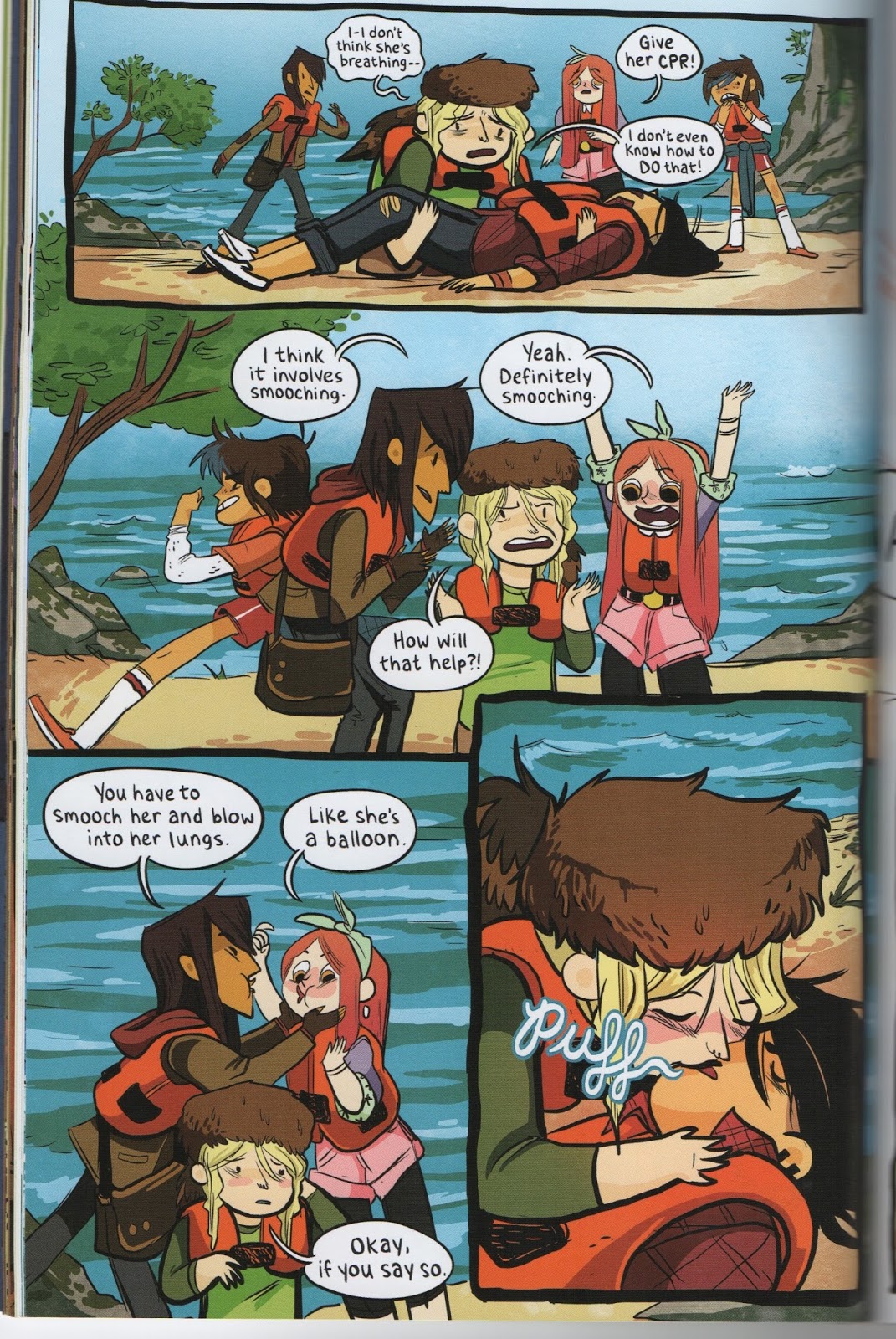
One comic series that is doing a fantastic job of portraying questioning characters is Lumberjanes. Molly and Mal are two of the five girl band that make up the leads of the Lumberjanes cast—and they’re totally adorable together. Their romance may be a bit in the background during the first two collected volumes—only really presenting itself when Molly tries to perform CPR on Mal after facing off on the river with a water dragon:


But their relationship takes center stage in the third collection, where even the plot mirrors their questioning of their own identities.

Sucked into a magical dimension, Molly and Mal have to decide if what they want (read as “getting back home” and as “a relationship with each other”) is something they’re willing to risk and be brave for.


For a couple of young girls, that’s a big, big step—and one that a lot of members of the queer community take at a similar age. The really awesome part is the support of the other Lumberjanes...


...and Molly’s and Mal’s conclusions.


Without portrayals of characters that can relate to the specific struggles of our daily lives, we are leaving out the experiences not only of our viewers, but of human beings in general. It’s time for the tropes to be broken and a whole new, human cast to emerge in storytelling—one that doesn’t tolerate the sort of hate that led to the tragedies of Orlando.

Orlando, this bisexual sister stands with you. And I swear that we’re gonna make this sour sweet.