Showing posts with label Japanese food. Show all posts

Friday, August 25, 2017

Yakiniku: My Beef with Dating Sims

Yakiniku with onions and ribeye has been one of my favorite Japanese style dishes since I was introduced to Japanese cuisine. It’s expensive, so it’s one of those things I only indulge in when I really want a treat—and I recently learned to make it at home.

Ingredients:
½ lb beef ribeye (or you can substitute a different cheaper cut in a pinch)
2 tbs unsalted butter
½ large yellow onion, thinly sliced
1 tbs cooking sake
⅔ cup white wine
1¼ cups water
3 tbs soy sauce
½ teaspoon ginger juice (grate ginger root and then squeeze the pulp to get this)
2 tbs sugar
¼ tsp very finely minced garlic
½ tsp salt
2 cups hot cooked rice

Optional Ingredients:
2 tbs beni shoga (pickled ginger) for serving garnish
2 large eggs to break over your yakiniku beef bowls just before serving

Serves two, so double the recipe if you’ve got four people in your family like I do.

Before you do anything, you’ll want to freeze your beef for an hour. This will make the beef rigid enough to cut into thin slices. Slice the beef very thinly, almost shaving it. In a saucepan over medium heat, melt your butter. Once melted, add your onions and cook until translucent, about four to five minutes.

You may also want to start steaming your rice now, if you haven’t prepared it already. Each cup of rice will become two cups once it hydrates, so one cup of rice will be enough to make the two you need. If you’ve got a rice cooker, you won’t have to pay much attention to this, but if you’re working with a pot like I am, here’s a great way to make sticky rice. If that’s too much work, just cook it normally in a pot and keep the lid on. Once the lid starts to jiggle a little, reduce the heat and let it simmer for about fifteen minutes until the rice is completely cooked through. After that, remove the rice from heat and let sit for another fifteen minutes without removing the lid. Washing and soaking your rice can also make a difference in how sticky your rice turns out, so consider letting it soak overnight or washing it vigorously before cooking it.

Once your onions are done to your satisfaction, add your white wine and cooking sake and let it cook for another two minutes. Next, add the water, soy sauce, ginger juice, sugar, garlic, and salt to the pan and mix well. I find it easier to do if I combine those ingredients in a measuring cup prior to adding them to the saucepan, as it makes it easier to dissolve the sugar in the other liquids and disperse it more evenly throughout the seasoning.

Next add the beef. Stir the mixture constantly to keep pieces of meat from sticking together and keep on heat until the meat is just cooked through. That should take about two to three minutes total.

Divide your rice between the bowls you’ll be serving the yakiniku in, then spoon the beef and onion mixture over the rice. If you feel like it, provide an egg for each person to crack onto their meal and mix with their beef. A garnish of Japanese pickled ginger called beni shoga will add a splash of color and a tasty side treat to the dish as well.

Hopefully you know what kind of media tie-in I’m about to make the leap to. But don’t worry, it’s not what you think. I’m not going to list off all the problems I have with dating sims. Instead, I’m going to talk about the beefiest dating sim of the year: Dream Daddy!


Dream Daddy is a dating sim produced by Youtube famous group The Game Grumps, and is a dating sim where you create a dad and then go forth to date other dads. Although there are definitely some really good dating sims out there in the world, this is the only dating sim that I know of that focuses less on the fan-service and more on the realistic portrayal of people.

Before even entering the game, the player is asked to choose a body type for their character. The game is body positive, offering players three different diverse body types. The game is also inclusive of trans men, mirroring the three available body types, but wearing binders.


After creating your Dadsona and jumping into the game, your first interaction is with your daughter, Amanda. Through your conversation with her, you establish your character’s backstory. Was their previous partner a man or a woman? Was your daughter Amanda adopted or born to you and your partner? The freedom allowed to the player with these dialogue options is momentous for a dating sim.

But the good feelings don’t stop there. In the game, there are six different dads to date. You can date every dad a total of twice before choosing to get serious about one of them—so the game doesn’t ask you to pick a favorite without getting to know them—but what’s exciting about each dad’s storyline is discovering how they go against the stereotypes you assume about them.

For example, let’s take Damien.


Damien is marketed as the goth, Victorian obsessed dad of the game. The achievements you get for going on dates with him are called Interview with a Vampire 1, 2, and 3. But Damien isn’t all that he seems. He’s a man who cares a lot about his clothes and about being able to do the things he likes, but he’s also afraid of horror movies.
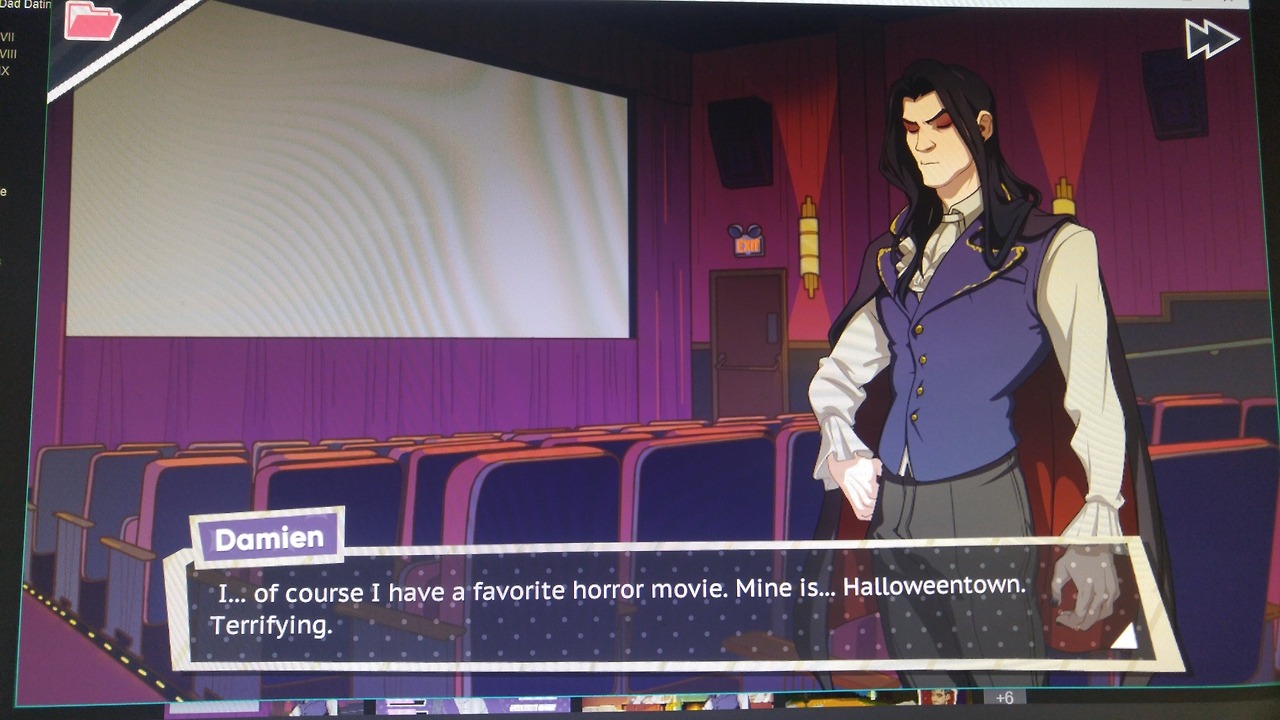


He enjoys the gothic pastime of strolling through graveyards because he feels it allows him to celebrate life.


And, if you compliment his clothes on your first date with him, he’ll talk about how important it is to him to be able to pick from a closet of period specific clothing—including binders.


Trans characters are often overlooked in media, so this tidbit of information that confirms Damien as trans while also not making a big deal out of it is a huge victory for the dating sim genre, which is often written off as shallow and there only to provide fan-service.

Damien isn’t the only character in the game doing his part for representation.

Craig, Hugo, and Mat make the cast ethnically diverse, making room for Asian-American, Latinx-American, and Black-American representation.


Mat represents how a person who likes people but has social anxiety acts in social settings.


Hugo represents the intellectuals who also enjoy “base” things like wrestling.


Brian represents how always trying to please someone else can backfire and make them think you’re competing with them instead—leading to an entire debacle over both people thinking the other one hates them. He also is an example of an overweight and active character—counteracting the stereotype that being overweight is a result of laziness rather than genetic disposition.


Joseph represents tolerant religious practice and how to be a cool youth pastor.


But it goes even further than that.

Craig, the dad who seems to be successful at everything he touches, is actually representing what high functioning anxiety looks like.


And Robert, the seemingly unfazeable bad boy of the dad group has some self-destructive tendencies that he doesn’t want to admit to himself. This realization is very difficult to get to, however, as if the player sleeps with Robert either of the times Robert tries to avoid the subject, he will discard the player as someone who is only interested in him superficially and can’t be trusted.


It’s worth noting that all of the dads have different familial make ups as well. Some have lost their past spouses like Dadsona has. Others have separated from their partners amicably. Others never had a partner to begin with, and still others may still be involved with their crumbling marriages.

What I’m trying to say, is this is a wonderful story in which you act as a real father figure to your remarkable photography major of a daughter, and also meet some other remarkable fathers along the way. Go play Dream Daddy and let it wash away your beefs with dating sims.

Friday, July 28, 2017

Miso Soup: But Not As You Know It

People travel, and people eat. When done in tandem, it becomes apparent that the way we’re used to eating something in one region of the world isn’t the way it’s eaten in other regions. America is a particularly interesting example, because it’s fairly easy to find food from all over the world here. Our diverse population is to thank for that. But when one travels to Japan and eats Japanese food, sometimes a thing we think we are familiar with confronts us with completely new flavors!

This was my experience with miso soup when I was studying in Akita—a city in Northern Japan that is considered to be fairly rural and spacious. The two kanji used in the name of the city reflect that, as they mean “Autumn rice.” As you can imagine, a lot of rice is produced in Akita. So are a lot of vegetables! So when I ate miso soup there, and found daikon radish and carrot in it instead of the “usual” tofu and seaweed, I was blown away. It grew on me, and now I find myself resenting that we only serve miso one way in the United States. Fortunately, miso soup is a fairly simple dish, and I was recently able to recreate the soup I ate in Akita two summers ago.

Ingredients:
1 small daikon radish
2 medium carrots
1 block soft tofu
½ cup white miso
9 cups of dashi

A quick preface: the ingredients list I’ve given above is for a main course miso, as in you’re planning on making it the main part of the meal. If that’s not the case and you’d prefer to serve this soup as a side dish, halve the recipe. There are also different types of miso out there! Miso soup is typically made with white miso as opposed to yellow or red miso. White miso is the least salty of the miso family. Yellow is more salty, and red is the saltiest! Be aware of this when picking out your miso and playing with the recipe. You can read more about different types of miso and their uses here. I’m sure you’re also wondering what dashi is. Dashi is a soup base commonly used in Japanese cooking. If you’re interested in making your dashi from scratch or making vegetarian dashi, here’s a handy guide. Otherwise, simply go to your local Japanese specialty store and grab some premade dashi packets. If you don’t have a specialty store near you, you can even order it online!

Now that you have all your ingredients and understand them to some degree, let’s get started. You’ll start by creating your dashi broth—either by boiling the ingredients you’re making it from scratch with in cheesecloth or by boiling one of the premade dashi packets you purchased. While you’re making your dashi, clean and cut the ends off your daikon radish and your carrots. Set the carrots aside for now, and cut the radish lengthwise, so you have two long halves. Slice each half into half moons. Set aside for now and turn your attention back to your carrots. You’ll want to cut them diagonally on the bias, so that each slice is a long strip of carrot.

Once done, check your dashi broth to see if it’s taken on the desired flavor. If it has, remove your dashi packet and add in your vegetables. Let the vegetables boil for a bit, then reduce heat and let them simmer. Turn your attention to your block of tofu and cut the soft tofu into the desired cube size for your soup. I find smaller cubes blend better with the vegetables, but larger cubes can be a fun way to break up the soup too.

Check on your vegetables. If they’re soft, we’re almost done! Make sure your soup isn’t boiling, or it will scald the miso during this next step and kill the probiotics present within it. Measure out your half cup of miso, but don’t add it directly to the soup. Instead, put a little on a cooking spoon or in a ladle (I find the ladle method allows me to mix more miso in at a time), and then mix the miso together with a bit of broth in the dish of the spoon/ladle using chopsticks. Once the miso is mixed in, add your tofu, give the soup a couple of stirs to warm the tofu in the broth, then serve and enjoy!

Like food, there are certain kinds of stories we get used to seeing one way. These become tropes, which inform our stereotypes, and ultimately just aren’t a reflection of the way people actually do things. One genre that is hugely guilty of this is the M/M romance genre. If you’re an anime fan, you may also know about the Boys Love genre of anime and manga, which consists entirely of stories about two male lovers for a female audience. Often, one character is branded the “uke” in the story—which literally means “receiver.” Since the genre is intended for female readers instead of actual gay men, the uke represents “the woman” in the sexual relationship between the two men in the story. Because of that, the sexual relations between the characters in Boys Love stories tend to be a little heterosexually informed and a poor representation of a realistic same-sex couple’s love life. M/M romance in America tends to have its own failings excluding gender roles from the same-sex pairings within their pages. However, the M/M sci-fi romance webcomic Starfighter does not.


Please be warned before you go looking up Starfighter on your web browser that the comic is an erotic one, and does include explicit material. None of the explicit pages of the comic will be posted within this blogpost, however, so don’t worry about NSFW content ahead.

Starfighter is set in the future during humanity’s first contact with aliens, a species called Colterons. The main story centers around a fighter and navigator duo, Cain and Abel. Navigators fly spaceships, fighters make sure the enemies the ship encounters explode. Neither can survive doing their job without the other. As you can imagine, this makes for some pretty reliant pairs. It can make partners obsessive, or controlling, or even territorial. Cain is a fairly territorial fighter, marking Abel as “his” with a bite-mark scar on Abel’s lip as soon as they are alone for the first time after their assignment. Abel is understandably upset—and refreshingly, doesn’t ever accept the way Cain first treats him as anything but abusive.

It’s only as Cain’s abusive behavior remedies itself that Cain and Abel become closer emotionally. And Cain does stop being such an asshat, I promise, here’s proof of one of his lackeys quitting on him because he cares too much about Abel now:


One of the other refreshing things about Starfighter, is that none of the sex Cain and Abel have is poorly disguised rape. One of the most unfortunate tropes in Boys Love and M/M is the case of the dubious consent in love making. Often times, the “fem” or “uke” character in the same-sex pairing will be unsure of their feelings and the sex they’re having with the other character. This takes the onus of sexual desire off of that character and places it on the other, more “masculine” character—which perpetuates and romanticizes silence culture in the bedroom and gender roles, where it is assumed that a man will always want sex and a woman never should. Instead of adhering to this trope, Cain and Abel are fairly communicative about their love making. Despite Cain’s possessive streak and his concerning behavior at the beginning of the story, Abel is very physically enthusiastic the first time he and Cain have sex. The reader is even treated to a play-by-play of how badly Abel has always wanted to have sex with a man and wants what is happening between him and Cain—which allows the reader to enjoy the scene instead of being concerned that Abel isn’t enjoying himself. Then, instead of feeling guilty over what they did or being unsure of his feelings, Abel decides he wants to do it again.


Abel takes a very active role in his and Cain’s intercourse the second time, destroying more of the heterosexual gender-norms that one partner is always acting upon the other. And, just in case those two things weren’t enough to blow M/M tropes out of the water, show that Abel is comfortable with his feelings, and convince the reader that Abel really does want to have sex with Cain, Abel tells Cain that he enjoyed himself afterwards.


Starfighter takes it even further, however. Whenever anal play occurs between two same-sex characters in M/M, often roles are assigned. One character will always penetrate, and one character will always be penetrated. Often, it’s easy to tell which character is which even before the characters have had any intercourse at all, because this trope often relies on lazy gender-coding. The penetrator is always masculine, aggressive, powerful—and the penetratee is always meeker, softer, and feminine. There are couples that break this coding out there, but they can be difficult to find. One genre in Japanese storytelling breaks it consistently, known as bara. The idea is to portray real men, with muscles and beards, having sex with each other. However, even bara falls prey to the strange heteronormative gender roles sometimes, where only one character will penetrate and the other will be penetrated.

Starfighter has Cain and Abel switch—you know, like a normal same-sex couple that engages in anal play might.


In conclusion, this is one of the most refreshing M/M romances I’ve read in a long time, that also has the bonus of being mega-hot and set in space. Here’s the link if you want to go experience it for yourself, and may you read many a story that has educated, healthy, and satisfying sex in it.

Friday, February 26, 2016

Ice Cream: Expectations

While I was in Japan, I ate a lot of ice cream—especially during the summer months. There were three flavors of ice cream that really struck me: matcha, sea salt, and soy sauce.

If you’ve gotten sea water in your mouth, doused sushi in too much soy sauce, or sampled really thick matcha, you might wonder why anyone would want to make ice cream out of such salty and bitter substances. Those of you who are familiar with the Sea Salt with Caramel Ribbon from the Portland Salt & Straw or any other strange flavor from your local artisan ice cream parlor may be less surprised—but when one hears “ice cream,” one often expects it to be something sweet. These three flavors offered an experience that was far from the one I had come to expect from ice cream.

Matcha ice cream is often served as a soft cream and topped with real matcha tea powder. It can also be found at any nearby Japanese Baskin Robbins in scoops. In comparison to the rich, dark tea taste of the Japan’s matcha ice cream, the green tea ice cream of the States is downright sweet.

Me with matcha ice cream.

Sea salt ice cream is the brainchild of the Disney Sea park in Chiba. Each area of the park is themed after a kingdom from a Disney movie. You can visit the center of the earth, Agrabah, and even Atlantica. Each area has its own theme for the food available. As you may have guessed, Atlantica’s theme is salt. Only “under the sea” is one able to get salted popcorn and the sea salt flavored ice cream that inspired Tetsuya Nomura, the creator of Kingdom Hearts. I had to try the ice cream in order to A) compare it to Salt & Straw’s version, and B) taste what had inspired the blue ice cream bars I’ve been coveting for most of my young adult life. The ice cream from Disney Sea comes in a cute shell and has a fruit center. The ice cream was tasty, and I enjoyed it for the novelty, but if you’re looking for truly delicious sea salt ice cream, I would recommend scheduling a trip to Portland and the Salt & Straw.

Me and two friends at Tokyo Disney Sea eating sea salt ice cream.

The last type of ice cream was the one I didn’t come to Japan expecting to try. I was raised to be the sort of person who will try any type of food once, so when a teacher mentioned soy sauce ice cream to me, I was intrigued. Soy sauce in Japan is far more than just liquid salt. There are different kinds, different flavor combinations, different levels of intensity of flavor. Picking a soy sauce can be as complicated as picking a fine wine. This was reflected by the ice cream. One might have expected it to taste salty. Instead, it tasted like one of those soy sauce coated rice crackers. There was something salty, yet sticky and sweet about it.

My very first soy sauce ice cream.

I want to talk a little about how expectation plays a role in media today—especially when it comes to secret identities and love triangles—or, as with Miraculous Ladybug (aka Miraculous: Tales of Ladybug and Cat Noir and Miraculous), love squares.

The two main characters of Miraculous Ladybug are the super heroes Ladybug and Chat Noir (he’s called “cat noir” in the English dub, but you get the idea). These super heroes daywalk as Marinette and Adrian. Now, get ready for the geometry. Marinette likes Adrian, but Adrian as Chat Noir fancies Ladybug, who is Marinette. Sadly, these two have no idea they’re just crushing on the other’s alter ego, and so Adrian is nice to Marinette, but not too nice, and Ladybug is constantly outwitting Chat Noir’s charming (if pun-tastic) flirting. The only thing keeping them from realizing who the other is? Their expectations about their different identities. Adrian’s ladylove couldn’t possibly be someone as ordinary as Marinette, and Marinette’s sweet kind-hearted Adrian could never be so full of bad cat-themed humor as Chat Noir…right? It’s going to be all kinds of fun when these two finally figure it out. Let’s hope it follows Sailor Moon’s example and cinches this particular plot bunny before the end of season one.

Marinette and Adrian visually expressing their love square in the Miraculous Ladybug opening.

Next, I know we’ve talked about Undertale before, but it bears bringing up again. Those of you nostalgic for the 8-bit games of the 90’s will want to pick up this particular little number. I don’t want to say too much, but those of you who have played know the merit of playing this game through twice. You may think you know what’s going on, due to your unspeakable experience with video games and understanding of plot…but that is precisely what the game wants you to think. Undertale is like a wine that gets better with age, because the second time you play it, you’ll come at it with a completely different understanding of the characters, the world, and the story you’re being told.

(This is where those of you who don’t want spoilers for the game should stop.)

For example, let’s talk about Mettaton. The robot celebrity is first met when the player enters the laboratory of Royal Scientist, Doctor Alphys. Alphys makes Mettaton out to be a robot that has gone rogue and is out for human blood. Mettaton then tries to kill the player through all manner of entertainment programs, ranging from quiz shows to cooking shows to Romeo and Juliet type drama—but each time he is about to succeed, Alphys comes through and saves the player. In the player’s final encounter with Mettaton, Mettaton tells the player that Alphys was fooling them the whole time. There was never any danger, and Mettaton would rather entertain humans than hurt them. He just played along so Alphys could pretend to help you.

As a player who has had plenty of villains try to sway my mind with lies, I immediately disbelieved Mettaton. No way he was going to get out of taking responsibility for trying to kill me multiple times just by trying to make out like it had been a game. No way he was going to undermine the bonds of trust and friendship Alphys and I had built by braving his trials together. So I paid him no mind, and I fought him, and I won, and Alphys told me she had one more lie she had to confess to me, and didn’t deny anything Mettaton had said, and when I played the second time around, it was obvious that Mettaton was acting. It was amazing how different my responses to Alphys and Mettaton were. Since my original expectation of Mettaton was that he was my adversary, I read all of his antagonistic text as serious the first time through. The second time, it was impossible to take him seriously.

The moment Mettaton made me laugh most on my second playthrough.

Even though the evidence was there the first time I played through the game, my expectation of what was going to happen overpowered it. And this is just one example of how Undertale uses your expectations against you—a sweet little reminder to keep an open mind.

Now go eat some strange ice cream.

Friday, January 22, 2016

Spirits: Whiskey in Japan

Recently, I found a whiskey bar in Shinjuku called Zoetrope. It was completely because of this list that I found it, but since it has been impossible to find a good drink anywhere in Tokyo up until this point, I was overjoyed.

Remember how I mentioned the Japanese love of sweet pervaded everything from cocktails to hamburgers? Yeah, I wasn’t kidding.

Those of you who know cocktails will know what I mean when I say that American cocktails typically make their cocktails “spirit forward.” Well, here in Japan, even the most spirit forward cocktails are made so spirit backward that I sometimes question why anyone would waste good scotch on a Japanese style Rob Roy when they could have it straight and actually taste the whiskey.

The large selection of whiskey that I was able to choose from at Zoetrope was a beautiful, savory, dream come true. I was surprised when I walked in and the bar was completely populated by men, however. Then again, I probably should have expected it. Japan has a thriving drinking culture, and one facet of it is the drinking businessmen do together after a day at the office. As Zoetrope specializes in whiskey, it attracts a specific type of crowd, and that crowd includes the businessmen. Zoetrope also attracts a lot of foreigners like myself because the owner, Atsushi Horigami, speaks fantastic English and is exceptionally welcoming.

If you don’t know anything about Japanese whiskey, let me give you a quick rundown: Once upon a time, a man named Shinjiro Torii imported a bunch of foreign whiskey. The whiskey he liked best was from Scotland. Then, in 1924, he started up his own whiskey distillery in Yamazaki city—a city near Kyoto that was known for its pure and delicious water. This distillery is known today as Suntory and is still one of the leading makers of Japanese whiskey today. The other distillery that has made a name for itself is Nikka, but the best whiskey that Horigami presented to me when I visited his bar was the Ichiro’s malt and grain whiskey. To learn more about this lesser known distillery and their delicious bottlings, click here.

Which brings me to this week’s media tie in: spirits (as in alcohol) and spirits (as in supernatural beings).

Recall the drinking culture of Japan I mentioned earlier? A JRPG called Catherine decided to include drinking in its game mechanics.


That’s right: the more drunk your character, Vincent, becomes, the faster he is able to move in his nightmares that night. This might seem like a funny ability to want, but when you’re climbing a tower that is literally dropping off beneath you, you’ll find every little bit of added speed helps. One only needs to consume three drinks in order to max out Vincent’s speed for the game play, but Catherine added a little extra incentive to drink at least four drinks each night: beverage trivia. Every night a new bit of trivia is unlocked for each type of drink that Vincent can consume. The options are beer, sake, a cocktail (Vincent always seems to end up with a Cuba Libre), and, of course, whiskey. When the player finishes a drink, the narrator of the game interrupts the game to inform the player of an interesting fact pertaining to the type of beverage they just finished. The trivia is interesting enough to keep one drinking enough to move quickly in the puzzle stages of the game even if the player is completely oblivious to the three drink counter to the side of the screen. Ranging from distilling techniques, naming conventions, and historical context, a new bit of trivia is unlocked per night, and if you have one of each beverage per night, you will be given the titles of “Cocktail Connoisseur,” “Beer Baron,” “Sake Sensei,” and “Whisky Wiseman.” If you’re curious, feel free to check out the video of all of the whiskey trivia below.


The next example of “spirits” is the punned version—supernatural beings. Spirits in media tend to be one of two types: either the spirits of the dead or the spirits of things, such as household items, trees, fire, and anything else that might possess a personality in the human imagination. Spirits can manifest in lots of ways, born from the residue of a life extinguished, born from intense emotion concerning a certain item, because there was simply a will to live within something, etc. In the Avatar: The Last Airbender and Avatar: The Legend of Korra franchises, the origin of spirits is rather unexplained. It becomes plain that they are different from humans, however, and thrive on all things magical and wild. During The Last Airbender timeline, the spirits exist in their own world known quite plainly as The Spirit World. However, in the events of The Legend of Korra, it comes to light that the world in which humans dwell was once shared between spirits and humans. The two portals that kept the worlds separated are opened, and the humans and spirits once again begin to live in the same world. This is not without its contentions however.

Avatar Korra lecturing a spirit about compromise

When the spirit and human world merge once more, both the living arrangements of humans and spirits are disturbed. The human’s great cities are suddenly overrun with magical flora, and the spirits are baffled by the technology humans invented to do things that magic had always been used for in their world. But the job of the Avatar, as illustrated in the above picture, is to keep the balance between humans and spirits. Why does this responsibility fall upon the Avatar’s shoulders? It’s because the Avatar is a human with a spirit living inside of them. As such, they are the unbiased party, the middle ground, between the two races.

It isn’t always an easy job, but regardless of the “spirits” you’re working with balance seems to be a good thing to strive for—even if you’re not the Avatar or teetering up collapsing nightmare puzzle towers! Drink responsibly and tastefully, everyone!

Friday, January 8, 2016

Sugar, Spice, and a Lack of Hot Sauce

I don’t like sweets. My mother brought us up without dessert, and I never developed a sweet tooth. I like savory food much more. Salty, spicy, and sour have always been my cup of tea over sweet.

The Japanese don’t agree, however. My host mother is never stingy with sweets after dinner, parading everything from fruit, to pudding, to chocolate before me, offering quantities of each until the volume of sweets rivals the volume of the meal I just consumed. I was forced to learn how to politely decline because eating so many sweets in one sitting is actually liable to make me sick. I also learned how to express my love for other tastes, since the beloved sweetness pervades even things I would normally think of as savory—seriously, everything from cocktails to burgers. I’ve had some success with finding things that are sour and savory, but the taste that eludes me most heavily is that of spice. While it IS possible to find spicy food in Japan, it is difficult, and more often than not when I receive a recommendation and try it out, the food is well seasoned but lacking any true hint of face-melting fire.

For those of you living in Tokyo, there is a delightful truly Mexican restaurant—and by that I mean you can get chimichanga and real hot sauce, not that it’s the true food of Mexico, but rather the Mexican food you know from the United States. Take the train to Harajuku station, proceed down the garish main street, and take a turn at Cute Cube, and walk down the dark alley until you see Chiles Mexican Grill and Cantina! There you will find an array of Mexican food that pleased even the skeptical Southern Californian we had with us. And if you’re looking for hot sauce, allow me to recommend their red habañero salsa. Whatever you want, salty, sour, hot, or even sweet, you can find it on this menu.

Which leads me to this week’s media tie in: real and diverse female characters that embody the full spectrum of humanity (tastes and all).

It’s true that in Japanese anime, there is usually a good representation of types of women. Sometimes these archetypes can be a little too strict, but more often than not I find that has to do with the quality of the anime as a whole rather than just the quality of the character representation. The reason so many different kinds of women show up in anime is simply this: there are more women included in the stories of anime and manga. When more women are included in a story, it allows for more diverse interpretations of them because no one woman is responsible for being the flagship representation of all womankind within the story. This too often is not the case with western media.

There have been two great examples of blockbuster movies recently that have broken this pattern. I speak, of course, of Mad Max: Fury Road and Star Wars: The Force Awakens. These two films pass the Bechdel test with flying colors, and also featured two very real and diverse female characters. Unfortunately when I say “diverse” in this context I can’t refer to much diversity of race. The Force Awakens does manage to portray many women who are of differing race—if not species, because this is a galactic setting after all—amongst its extras and bit parts, but when I use the word “diverse” to describe Furiosa from Mad Max and Rey from Star Wars what I mean is that they are not characters that embody the stereotypical heroine of Hollywood. Since Rey and Furiosa are surrounded by other female characters, they are allowed to be more than one type of person: they are allowed to come from a damaged background, to be afraid, to be angry, to be rash, to make mistakes, to be hurt and everything else a normal human might experience during their life time—without it coming off as a generalization about all women. So when I say that Rey and Furiosa are “real” and “diverse” as characters, it is because they are human—and humans are not always stuck in one mood or type of behavior.

Furiosa is a child that was stolen from her family, a woman who lives in a society where her gender is forced to be breeders or nutritional providers, and a person with a disability who uses it to her advantage—did you see how useful and versatile that mechanical arm of hers was in the movie? In the face of all of these things, she has managed to secure a position that allows her to help other women escape from their lives as kept wives. But, although Furiosa is obviously a very powerful, skilled, and brave woman, there are moments when she is allowed to break down and mourn. Furiosa’s plan for getting her charges to safety is to return to her childhood home, known as “The Green” within the narrative. When they arrive at the place that used to be The Green, it is gone; used up and infertile. At this point in the narrative, Furiosa—understandably—grieves. Not only has her plan failed, but she has lost a home that she hoped to regain. And, because she is surrounded by other women, she is allowed to do this without it being because she is a woman. The other women do not mourn with her, making her show of emotion about the failure of her plan and the loss of her home rather than an emotional sensitivity that comes with having a vagina. The presence of more women makes her grief more powerful.

The presence of other women also allows the partnership that Max and Furiosa develop to be devoid of the gender dichotomy of which gender is superior at something. There is a moment when a target must be hit for the group’s escape to The Green to continue. There are only three bullets left for the gun that can make this shot. Max shoots two of these bullets and misses both times. Furiosa carefully approaches him but says nothing. She extends her hand, and Max gives her the gun. Furiosa then lines up the shot, using Max’s shoulder as a stand, says “Don’t breathe,” and shoots. She hits the target. Now, if Furiosa had been the only female character in this story, the power of this scene would have been polluted with gender politics. Since she was not, the scene represented instead the level of trust Max now has in Furiosa and how skilled Furiosa as an individual is.


Rey is afforded the same freedoms as Furiosa due to the presence of key characters like Maz, General Leia, and Captain Phasma— not to mention the female storm troopers, spies, and resistance personnel. Rey also breaks new ground for her franchise.

Although the original screenplay for Star Wars: Return of the Jedi included Leia becoming a Jedi too, Carrie Fisher was too physically dependent on cocaine at the time. Because she was physically unable to fulfill the role, Star Wars fans had to wait until The Force Awakens to see a main female character become a Jedi—and Rey isn’t quite all the way there yet canonically, but it would be silly of Disney to keep her out of the Jedi club now, considering her evident connection with the Force and the way she took down Kylo Ren in that lightsaber fight.


What was great about Rey’s freedom as a character was her relationship to the Force and all things Jedi and Rebellion. With Maz and Leia being the biggest patrons for the Force, the Rebellion, and the lightsaber itself within the narrative, Rey was free to have the possible return of her family matter more to her than getting involved in a galactic war or even flying away with Han Solo without it meaning that women weren’t meant for the Force. She cared for her family, she was afraid of the lightsaber, she lost to Kylo Ren the first time he encountered her in the woods… And then she was put in a stressful situation that forced her to utilize her connection to the Force and become comfortable with it. And none of her reactions could possibly be construed as motivated by her gender.

Just goes to show that the more flavors you have available, the more freely everyone can behave. Now pass the kimchi, please.

Friday, December 25, 2015

The Holidays: Noodles, Cake, and Fried Chicken, Oh My!

Here’s the thing about Christmas in Japan: It is not the Christmas you know. And don’t even get me started on Hanukkah…

In Japan there are two things that are “traditionally” eaten on Christmas: cake, and KFC. No, you read that right. It doesn’t stand for something else. I am, indeed, speaking of Kentucky Fried Chicken.

The reason for this? Christmas is a secular holiday in Japan. One might say that Christmas in the United States or other countries is also a secular holiday, but Japan is secular in a different way. In America, we have some pretty specific traditions regarding decoration, meals, familial togetherness, the spirit of giving, and cookies left out for Santa. In Japan, only children receive gifts on Christmas, and the day is more about couples loving sharing a “Christmas Cake” than the family being together. Christmas isn’t considered a national holiday, so most people usually have to go to work. And as for the chicken? Well, like with hamburgers, it looks like that’s our fault too.

So instead of focusing on the Christmas foods of Japan, I thought perhaps talking about the symbolism of the long New Year’s noodles would be more interesting.

Everything the Japanese eat on New Year’s has some sort of symbolic nature. Here’s a bit about the dishes I won’t be talking about, because the dish I find the most interesting is the one traditionally eaten on New Year’s Eve that symbolizes “crossing over to the new year” with its long noodles. Known as omisoka or toshikoshi soba, this soba noodle soup is made—you already know this if you read the name of the dish—of buckwheat soba noodles. The important part of this dish is that the soba noodles are made looooooooonnnnnnngggggg to symbolize a long life and so that you cut them with your teeth and let go of any hardship from the past year.

I’ve never made soba noodles before, but I have made long egg noodles to celebrate the New Year. Shout out to my good friend Ceili Shannon for hosting the noodle making party and teaching me how. All you’ll need is flour, some eggs, and your favorite spices (I ended up throwing oregano and mace into my noodles—they were delicious). Here’s a quick recipe for making egg noodles. You can twist them into fun shapes or cut them into thin strips. Ceili had a noodle press that flattened out our dough and cut them into noodles at the same time, and it was really convenient if you don’t feel like the hassle of doing it by hand. For those of you who want to make the soba itself, here’s a recipe for the special New Year’s dish.

As for a media tie in… It’s Christmas for me, and almost New Year’s for all of us. Go watch your favorite holiday movie—or if you’re at a loss, may I recommend to you Over the Garden Wall? Completely secular, made up of ten ten minute episodes, and you will watch it twice, have your mind blown, and be so happy to be alive that you’ll open the new year with open arms and determination!—and then binge play Fire Emblem or Undertale or any of those other games in which you should really name your protagonist after yourself for heavy emotional impact, and eat some good food to bring in the new year.

Happy holidays, everyone!

Friday, December 11, 2015

Gyoza: Complete as One Part of a Series

My host mother surprised me with a gyoza making lesson the other day. Here’s how it went down:

Ingredients:  cabbage, chives, ginger, garlic, 1 package of gyoza wraps, ground meat of choice (we used pork, but lots of people use beef).
Seasonings: sake, sugar, soy sauce, sesame oil, and salt.
  1. Check the back of the gyoza wraps to see just how much all of your wraps can hold. This will determine exactly how much of the other ingredients you will need.
  2. Mince all ingredients and mix together in a large bowl.
  3. Mix seasonings and pour over gyoza filling.
  4. Mix again.
  5. Ready a glass of water, and open your gyoza wrappers.
  6. Make the dumplings!: Place your filling inside the wrapper. Then dip your finger in the water and moisten the edges of the wrapper. Close the wrapper to create a gyoza dumpling. You can try pinching the wrapper as you close it strategically to make little creases in the dumpling.
  7. Cook in pans with olive oil in the bottom—covered!—until browned.


Here is a more exact recipe, and here is one with pretty pictures that covers the dumpling making process since I was too busy getting my hands dirty to take pictures.

The thing about gyoza is each dumpling is complete on its own. Served as an appetizer or a side, just one would be completely acceptable—but they’re so tasty that we often want more than one of these delicious dumplings to complement the last one.

And, what with Hanukkah happening as we speak, I’ve got series with stand-alone segments on the mind anyway. My two best examples of media that manages to pull off stand-alone segments are Mushishi and Undertale.

If you ever wondered what a Hayao Miyazaki movie might feel like it if it was packed into a twenty two minute anime episode, you need look no further than Mushishi.  Full of fairytale like mysteries and beautiful Meiji era Japanese nature scenery, the series sets a quiet, peaceful mood that allows the viewer to feel as if they’ve experienced a revelation that lasted longer than one episode of anime. The reason for this is because Mushishi is the story of… well, of the supernatural beings called mushi, really. In each episode a new set of people deal with some sort of effect of the creatures called mushi. Mushi as defined by the show are the most primitive form of life. They are like fairies or ghosts in a way, because not everyone can see them, and they often cause trouble for people without meaning to. The only consistent character is the traveling Mushi Master, Ginko. Because of this, every episode is very dense. There’s hardly any pre-existing knowledge necessary in order to watch each episode—except that Ginko knows a lot about mushi and how to deal with them, but that’s established in every episode anyway when he explains what he does to the new set of characters. There are some episodes that are connected and go further into the past of Ginko the Mushi Master, but every episode is filled with new characters, a different kind of mushi, and its own set of themes.

Mushishi is one of those shows you can accidentally watch out of order or skip episodes on and never even realize it because each episode stands on its own so well. When the second season of the show came out, I accidentally watched the second half of the season before watching the first half. The story is also available in manga form.

Mushishi screen cap. Mushi dealt with appears in the form of a reversed rainbow.

Undertale is a different breed of stand-alone from Mushishi. It seems like a nostalgic RPG when you first start playing. You play as a human child that has fallen into the sealed underground world of the monsters. Your goal is to get back to the surface. However, it very quickly becomes apparent that this game is nothing like the RPGs from your childhood. Whereas in something like Pokémon one would always fight the wild Pokémon and other trainers even if one intended to catch or befriend them, fighting is something you can’t do if you want to get the best ending for Undertale. In order to really understand everything that’s going on in the background of the game, the player must run through the game three times. Fortunately, Undertale is relatively short, and once you achieve the Neutral Ending—because I can almost guarantee that is the ending you will receive on your first run through of the game—it’s possible to run through the game again and get the Pacifist Ending (so called because in order to get it you mustn’t kill any of the monsters you encounter) in less than a day. From there I don’t recommend actually trying to get the Genocide Ending. In order to get that ending the player must kill every monster in the game and actually trigger a certain number of encounters in each area for the sole purpose of killing monsters. Aside from taking a lot of time and effort, there are consequences for completing a Genocide run of Undertale: it is impossible to ever truly receive a Pacifist Ending again.

But in order to truly understand everything that’s going on in the world of Undertale, it’s important to receive all of the information that exists in all three story lines. If you’re personally interested in playing the game and having all three experiences, I would recommend Youtube to you as a resource after completing a Neutral and then Pacifist run.

The reason each run of Undertale stands so well on its own is because of how the responses and futures of the characters and the world change based on the player’s actions. In a Neutral run, Undyne, the strongest monster in the land, will sneer at the player for having killed any monsters at all, telling them that they didn’t need to and that they only did it because it was easy for them. However, in a Pacifist run, she will sneer at the player for putting on a “goody-two shoes” act. In a Genocide run, she simply vows to kill you. Nothing is the same from run to run, and so each play through stands on its own to give the player a new experience and enlighten them to a new facet of the game.

Undyne’s dialogue, prefight on a Neutral run.
Undyne’s dialogue, prefight on a Pacifist run.
Undyne’s dialogue, prefight on a Genocide run.

Now you’ve got two new things you can do on those days when you only have time for a little bit of something. Enjoy your dumpling sized helpings of anime and video games!

Friday, November 27, 2015

Oyakodon: Today I am Thankful for my Family

November is coming to an end, and I'm thinking about Thanksgiving. Of course, making a turkey dinner in Japan is a little difficult, but there is a dish that seems to convey the idea of family and makes a meal of itself. Oyakodon (親子丼) or, in English, “parent and child donburi” is a dish that uses both chicken meat and eggs. The use of both chicken and eggs together is where this dish pulls its name from. Some of my western friends thought this was creepy, but I thought it was rather sweet. It reminded me of all the family—both that of blood and that of heart—I have back home that I'll be missing this year.

Here's the way I made oyakodon with my host mother, Motoko Okada:
Ingredients:  4 onions, 3 carrots, 3 small green peppers, 1 small chicken, 5 eggs.

  1. Julienne and sauté all veggies (in order of appearance). Add sake, some chicken stock (dried) and a bunch of water and simmer for a bit.
  2. Marinate chicken with ginger, onions, garlic, salt, and sugar for a nice taste. Best if done the night before.
  3. Remove chicken from marinade and grill.
  4. Mix eggs and cook separately.
  5. Once everything is cooked to taste, lay ingredients over a bed of rice and serve.

Here’s another recipe too, if you find my hurried notes too inexact.

It felt right to make this with a maternal figure during this time since it’s still Thanksgiving in my silly American heart even if the people in Tokyo aren’t celebrating it. But it got me thinking… How often do we see healthy familial relationships in media? Can you count the number of them you’ve seen in the last week? Are you only using one hand? Yeah…

When I first heard the name oyakodon and was told what it meant, it actually immediately reminded me of one of my favorite scenes from Fire Emblem: Awakening.


Those of you familiar with the Fire Emblem series will remember the support system of the previous games that allowed you to build relationships between your army’s units. But in Awakening, the support system also allows the player to meet the offspring that result from the romantic support links. These children travel back to a time before their parents have conceived them in order to prevent the tragic events of the future they come from—in which most of their parents have died and the world has been overrun by darkness and chaos due to the Fell Dragon Grima—in order to attempt to save their parents and to build a future in which they can all live happily together. When Chrom, the main character of Awakening, meets his daughter Lucina and hears her story, he reacts not as a soldier or as the Exalt, leader of the country of Ylisse, but as a father—and it is so much more emotionally powerful than any declaration of war he could have made on Grima.

Those of you less familiar with niche JRPGs will remember The Incredibles. Part superhero movie and part family romcom, each member of the Parr family has a pretty “incredible” power; Dash has enough speed to allow him to play as many pranks as a young boy could think of; Violet’s invisibility and force fields allow her to admire the world of high school without ever having to worry about stepping foot in it; their mother Helen’s ability to stretch makes her more than flexible when it comes to balancing house work, her third baby, and the rest of her family; and Bob’s colossal strength should be more than any father could ever need in order to protect his family. In a way, these powers reflect the things we as normal viewers might stereotypically wish we had in our everyday lives. Wouldn’t it be great to be fast enough to get away with pranks? To not have to worry about what might happen to you going out on a Saturday night regardless of what you were wearing? To be able to stretch far enough that you could be in three places at once? To be strong enough to protect everyone you loved?

But the point that is very quickly made is that no matter how incredible someone is, no one is ever strong alone. From the beginning of the movie, Mr. Incredible starts losing to the machine that Syndrome made. It’s not until the entire family starts working together that they’re able to defeat both the robot and Syndrome. The toll it takes on Mr. Incredible when he thinks his family has died is also indicative of how important familial bonds are to us. The Incredibles really drives home how much of a superpower familial love is.


Now, those are conventional families portrayed by media. When it comes to less traditional forms of family, Steven Universe and Gravity Falls have it made.

Steven  of Steven Universe is the offspring of Greg, a human, and Rose Quartz, a sentient alien rock called a Gem that we would typically gender as female on sight. Because of his dual lineage, Steven has a very interesting familial structure. His mother gave up her physical form so he could be born. Steven lives not with his father (although his father does run a car wash nearby) but with Pearl, Garnet, and Amethyst—all of whom are also Gems—as one of the team members of the Crystal Gems. It was decided this would be the best living situation for Steven because only other Gems could possibly hope to teach him to control his own Gem powers.

When the series starts, the viewer knows very little about Gems. As the series continues, we learn that they come from all sorts of situations and backgrounds, and that the Gems Steven’s mother led to earth are considered radical in their ways of doing and thinking by “homeworld” Gems. We learn that Amethyst was artificially made, that Pearl would be restricted to servitude instead of being allowed to engineer, create, and fight the way she does as a Crystal Gem team member, and that Garnet—who is made up of two other Gems that are in love—wouldn’t be allowed to exist as a fusion of these Gems. Steven’s family is full of diversity. It is the acceptance, communication, and love the characters exhibit in every episode that keeps it going and allows them to fight off homeworld Gems still hoping to invade and colonize the Earth.


Gravity Falls is a show that balances relationships between blood family members and non-blood family members more brilliantly than any other piece of media I’ve ever seen. 

The series centers around a pair of fraternal twins, Dipper and Mabel, who get shipped up to their Grunkle (that’s Great Uncle turned into one word for the purposes of a joke in the series) Stan’s tourist trap The Mystery Shack in Gravity Falls, Oregon for the summer. Once there they meet Soos, the handy man of the shack, and Wendy, one of the gift store attendants. The only people related by blood are Stan, Dipper, and Mabel, but when the apocalypse happens in Gravity Falls as the series finale, and Dipper, Soos, and Wendy break into the Mabel’s dream prison to save her, they are referred to as “The Pines Family” by their adversaries.

And that description is not inaccurate. Series creator, Alex Hirsch, recently discussed a couple of the relationships between the characters on The B Movies Podcast, saying how he really made it a point to fill relationships that are usually fraught with tension with love instead. This is evident in key relationships, such as the twins themselves and the father and son type relationship Soos and Stan have as well.

It also seems to fit, because no matter what happens in the show, Dipper, Mabel, Stan, Soos, and Wendy always get through it together.


And if that’s not enough to convince you how powerful and important the portrayal of warm, loving familial relationships is, refresh yourself with this scene from Lilo and Stitch:


Happy Thanksgiving, wherever you are, whatever you celebrate, whatever language you speak. I hope your loved ones are near and that you can see them today, because life is heavy and life is hard and it’s so much lighter when they’re there to help you through it. May you find many a loving portrayal of family in your media and in your living room this coming holiday season.

Friday, November 13, 2015

Okonomiyaki: Mix it Up!!

Okonomiyaki is often described in English as a seafood pancake. While this little Osakan foodstuff may have started as only a seafood dish, the mixed nature of the ingredients lends itself to endless variations.


How does one make it? Let me show you:


First you start with your bowl of raw ingredients.  The base is usually one of cabbage, egg, flour and water, although traditionally grated Japanese mountain yam Nagaimo is used because of its viscosity and distinct ability to hold an okonomiyaki pancake together. The other ingredients are according to ones tastes—although I admit that my favorite combination was the tuna. Once you get your bowl of ingredients, you mix it up until everything is coated in a thin layer of the egg/flour/water combination. If you don’t coat the ingredients fully, you may end up with okonomiyaki pieces instead of pancakes.

Once you’ve mixed your ingredients into a satisfactory jumble, it’s time to grill them. With a griddle table like this, you spread the mixed ingredients on the table, give them an extra chop with the metal cooking spatulas, and then form your pancake.


But once you’ve finished grilling your okonomiyaki, the diversity doesn’t stop. Now you get to pick your toppings! Common toppings include okonomiyaki sauce, mayonnaise (the lighter Japanese kind), seaweed flakes, and thin fish flakes.


And even then, this is only one way to make okonomiyaki! Here and here are a few other ideas on how to make it if you’re interested.

But the reason I bring up okonomiyaki this month is because of the powerful nature of mixing things. Let me present to you two examples: Samurai Champloo and Star vs the Forces of Evil. Samurai Champloo is an Edo period samurai story that is blended with hip hop. It may sound like an aesthetic that’s impossible to achieve, but people said the same thing about chocolate and peanut butter.

The series opens with a title card that tells the viewer the story that follows won't be historically accurate, and then rewinds from a present day hip hop scene to the Edo period. From there, the viewer encounters many things they never would have during the Edo period, from little things like the addition of glasses to an old-school ronin samurai ensemble to big things like the inclusion of graffiti tagging culture and fighting styles that include breakdancing.


But aside from the initial statement that the story won’t be an accurate historical portrayal, the anime takes the experience a step further. When one is blending two things that wouldn’t usually go together, one has to think about every aspect. Since Samurai Champloo is a TV show, that means the creator gets to work with content, visuals, and music.


The Samurai Champloo soundtrack is chock-full of hip hop, this being one of the songs included. It’s ultimately the choice of soundtrack that I think works as the batter to hold the work together. It sets the mood and gives the viewer an expectation for the hip hop references and paraphernalia that appears throughout the story. Music can often be used this way. Take the opening for Star vs the Forces of Evil as an example.


Here’s a song about rainbows and puppies sung by a man for a children’s TV show. This is exactly the sort of amalgamation of pretty and powerful I’ve been looking for in children’s cartoons since Sailor Moon debuted in America when I was a kid. Although more subtle than the combination of Edo and hip hop, the combination of gendered items surrounding the main character of Star vs the Forces of Evil—characteristically named Star Butterfly—sends a powerful message about Star’s ability to be herself. Take a look at her room.


When she arrives on Earth to live with the normal, California-based Diaz family, Star works a little magic with her wand to create her own room in their house. What you’ll notice about the above screen captures of this room is the juxtaposition of “feminine” and “masculine” (we’re going to use quotes for those terms because items don’t actually ever connote gender)—a sword in her chest of stuffed animals and jewelry; posters hanging in one corner and weapons in the other; and, of course, the princess-like canopy bed and the morning star resting upon it. Star’s outfit is an amalgamation of things as well, combining a skirt with spiky shoes and a devil horns headband. In the very first episode, Star introduces herself as a princess who likes to fight monsters and tame wild unicorns.  The blend of masculine and feminine in the character of Star Butterfly is one of the most refreshing blends I’ve seen on TV in a while because it’s real: every person is a combination of traits our society has come to define as “masculine” or “feminine” when they’re really just “people-line.” Star doesn’t really need any batter to hold her together because she’s already so realistic, and her portrayal just helps us to break down the fake barriers between people our society created until we can accept her as normal—again, like peanut butter and chocolate.

I wonder if they have Reese’s Peanut Butter cups in Japan, because now I have one heck of a craving. Have fun mixing it up, everyone!