In my family, I was the only grandchild that wanted to go to Greece. My grandfather was more than happy to send me on a six week volunteer program with the American Farm School in Thessaloniki, Greece that his brother had made a large donation to many years ago. The really neat part about the American Farm School? All the fresh produce. They even had their own bees! My fellow high school aged volunteers and I enjoyed many of the fruits of the school’s fields. We ate honey comb, we sampled their wine, and we were even privy to a cooking lesson or two. One of the things I was taught to make while I was in Greece was the rejuvenating cucumber yogurt sauce, tzatziki.
Ingredients:
Two quart containers of plain Greek yogurt
Three large cucumbers
Juice of three large lemons
One clove garlic (more won’t hurt you if you want more)
One large white or yellow onion
Fresh dill
Pepper to taste (you can add salt too if you like)
First, get two bowls—one large enough to hold your tzatziki when it’s finished, and another for compostables. Next, peel and slice the cucumbers. I like to halve my cumbers and then slice the halves, but you can quarter your slices too or leave them whole. I find halved and quartered slices are easier to fit in one’s mouth, but the size of slice won’t affect the taste. Next, chop your onion and add your garlic. You can work with minced garlic for the next part if you’d rather not mince your clove by hand, but I find fresh garlic achieves the best taste. Once you have your three ingredients in the bowl, pour the yogurt in and mix. Once ingredients are sufficiently mixed, juice your lemons, pour the juice in, and mix again. Finish off by chopping or hand tearing your dill and sprinkling it and a dash of pepper into the mix. Mix one final time and taste. If you’d like a tarter flavor, more lemon juice is what you’ll need. If you want a little more spice, add more pepper, not more garlic. Garlic is very powerful and if you add too much it can overpower the taste of the cucumbers, dill, and onion. If you find your tzatziki is too watery for your tastes, you can always salt your cucumbers or press them to remove moisture there. This version is ready to serve as soon as you’re done making it, just like we did in the kitchen at the American Farm School.
That recipe is a Thessaloniki recipe for tzatziki. Should you ever travel to Greece you’ll find that different cities will dress your gyros differently. Greece was a nation of city states for quite some time, and so things vary from city to city. In Thessaloniki it will come with ketchup, mustard, and french fries. In Athens, tzatziki. As you might expect, though, the different regions of Greece make their tzatziki differently too. There are as many versions of this recipe as there are variations of the Greek Myths. Here’s a recipe for Athenian tzatziki that uses more garlic, table spoons of olive oil, and no onion or lemon juice for a different kind of taste. It also has measurements if that’s your thing—we all know it’s not mine by now.
Ingredients:
½ a large cucumber, unpeeled
1½ cups plain full-fat Greek yogurt
2 large garlic cloves, finely minced
2 Tablespoons extra virgin olive oil
1 Tablespoon white vinegar
½ teaspoon salt
1 Tablespoon minced fresh dill
This version of tzatziki takes a little longer. First you’ll want to grate the cucumber and drain it through a fine mesh sieve overnight in the fridge. You’ll want to combine your yogurt, garlic, oil, vinegar, and salt in a large bowl and refrigerate them overnight as well. The next day, just throw your cucumber in with the rest of the ingredients, add your dill and mix.
Now, this snack, dip, or tasteful side dish is one of my favorite refreshing foods for the summer. There's protein, cucumbers, and it goes well with everything. It leaves me feeling full—not only in stomach but also in spirit. The one cartoon I continually come back to for the same feeling is Over the Garden Wall created by Patrick McHale.
Over the Garden Wall is a cartoon mini-series that embodies the same rejuvenative goodness as our tasty cucumber yogurt sauce. Just in case you require more proof than my word...
The pilot episode featured a vegetable car that brothers Wirt and Greg and human-girl-turned-blue-bird companion Beatrice were trying to fix up. The cucumber wheels on the vegetable car are not the only reason I keep coming back, however. Whenever I feel lost, this show gets me.
Made of ten, ten minute episodes, Over the Garden Wall tells the story of two brothers lost in the woods. Initially, it feels very fairy tale. The premise, the setting, even the dialogue trick the viewer into thinking they know what’s going on (similar to Undertale). Very quickly, however, every expectation and trope is turned on its head. Wirt and Greg are not two fairy tale heroes. Instead, they come from a very modern town, and their fanciful costumes come from their Halloween festivities. In reality, Wirt and Greg have fallen into a lake and are in the process of drowning.
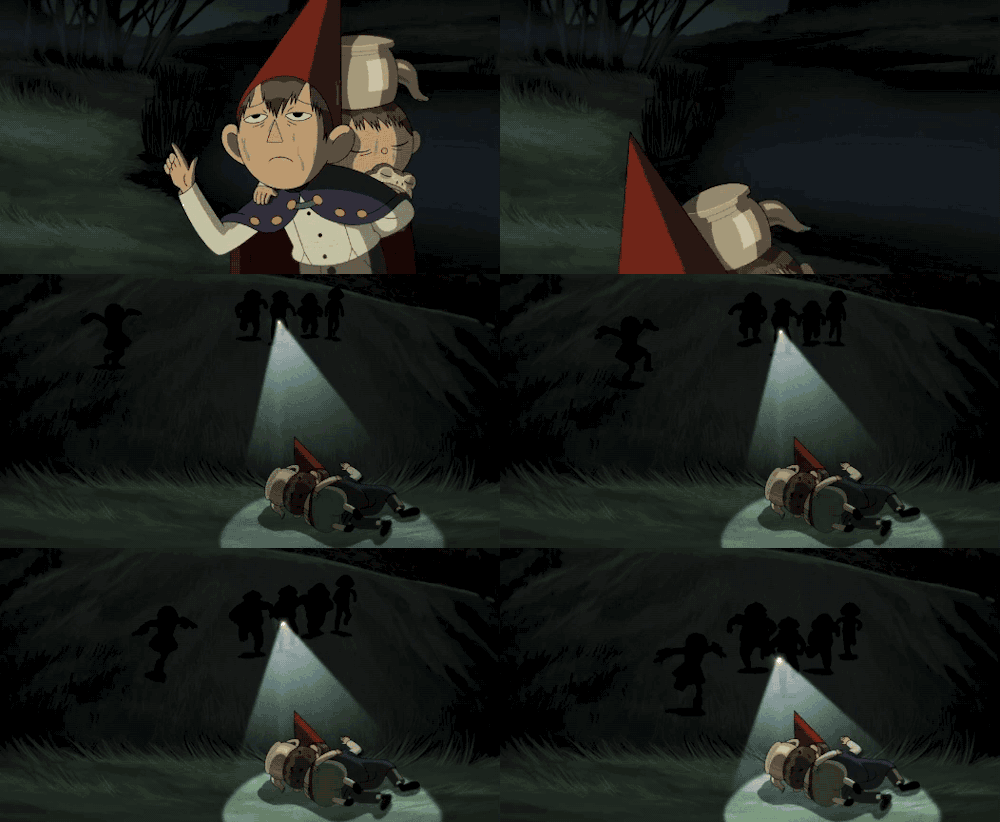
None of this comes to light until the ninth episode of the series, however. The entire time, the viewer is tricked into thinking they understand Wirt and Greg’s circumstances, that they know what motivates and moves them. This is a constant theme for the series, as the stories woven throughout the ten minutes episodes are only small glimpses into the worlds and lives of the characters.
The story is set in a wood called The Unknown—a fitting name, since even the show’s greatest fans can’t seem to decide what kind of place The Unknown actually is. In a graveyard in Wirt and Greg’s reality the gravestone of one Quincy Endicott is visible. During the events in The Unknown, Wirt and Greg meet a Quincy Endicott who is alive, well, and in love with someone he believes to be a ghost. Since Wirt and Greg’s lives are also in jeopardy, does this mean The Unknown is the land of the dead? Beatrice and her family seem to live in The Unknown, however. But have they only been doing so since they were transformed into blue birds? Even if that is the case, how would this land them in a world of the dead? A small toy boat set on a river by two boys in the opening sequence of the series becomes the ferry boat for Wirt, Greg, Beatrice, and a host of frogs. The moon never changes phase. The season is decidedly autumn, but moves into winter with snow and ice as Wirt and Greg begin to question if they will ever get home. The toys of a toymaker come to life and sing songs of their roles to each other. A woodsman grinds trees into oil to keep the lantern he believes his daughter’s soul resides in lit. Perhaps instead, The Unknown is a place we create in our minds—a sort of blend of reality, dream, and perception. Although there’s plenty of evidence to suggest this theory, there’s also plenty of evidence to support the land of the dead and a slew of other theories. Honestly, The Unknown resists interpretation.
And that is precisely what I love about it.
Over the Garden Wall is one small story in a world where there are many. The viewer can’t understand them all. Nothing is laid out and made clear except the story of Wirt, Greg, and Beatrice. So much of what happens around them, to the characters outside of their troupe, and in the world isn’t covered—and it’s that great big real-world wonder that leaves me satisfied at the end of the series.
The woodsman comes home to his daughter. A dishonest horse finds a way to make an honest living. The frogs find their mud to hibernate in. A young girl and an old crone bound by circumstance find a way to be family after that circumstance is broken. Beatrice returns home to her family. And Wirt and Greg finally make it home. We see the endings of these stories, but plenty of the middle and sometimes even the beginning is left out.
There are four comics that complement the series and get into some of the bits of story the viewer doesn’t see in the original cartoon series, but even with that coverage, one will never truly know everything about what rests over the garden wall. Not that the viewers will ever stop trying!
You see, Over the Garden Wall is much like our own lives. We are one small story in a world that we can’t possibly hope to know everything about. We simply live in it. There’s no way to know where everyone came from, or what they might do. Reality doesn’t conform to the tropes of a story book. Refreshingly, neither does Over the Garden Wall.
Showing posts with label animation. Show all posts
Friday, May 27, 2016
Saturday, May 14, 2016
Comfort Food: Weddings Are Draining and I'm Too Tired to Think of a Clever Title
Okay, honestly, I didn’t have time to get this done because weddings are so crazy.
I’m not planning one, but one of my best friends is, and watching the stress eat her alive is not fun. It’s stressing ME out too! No one has the time, energy, or resilience to deal with this!! Go watch this video about how stressful we’ve made weddings in America!
Anyway, because of that, I’m doing a bit of a fall back post, and it’s late, and I’m sorry. Really, it’s just what I do for comfort food when I’m exhausted and don’t want to deal with the idea of cooking for an evening. It is, the poor man’s ramen. I buy Top Ramen noodles, I put half of them in a bowl. I then place onions, carrots, and two slices of ham and/or two pieces of salami in the bowl, spice it up with half the spice packet, some red chili pepper, and some red chili flakes and then cover it and wait for two to three minutes depending on how zonked out I am. I eat this a lot when I forget to cook or buy groceries or eat in general. It hydrates and even has some nice vegetables in it. As a bonus, the hot from the red chilis gets my head in the game, and the salami adds its fat to the broth.
I’m a fan of soup in general. I think of it as the ultimate form of sustenance, because it is both beverage and food-stuff in one. This is why it’s my favorite comfort food.
Speaking of media that is comforting, after a long day I want one of two things: something sweet and adorable or something rude and irreverent. There are two cartoons I turn to to provide these things.
The first is Wander Over Yonder. Never have I seen a cartoon with such a sweet, sensitive, and considerate male character. The cartoon even manages to make the supposed villains endearing and relatable. In a kids’ show, I just can’t get over it, okay? It’s a critique on stereotypes of all kinds, it doesn’t ask me to think too hard, and Wander is constantly pulling out his banjo to help someone with a song. Go watch some, you’ll be glad you did.
The second is Bob’s Burgers. From Tina’s obsession with butts to Gene’s fart jokes to Louise's Bond villain level plots, this show is everything I want in television that makes fun of my life and offers commentary. It always makes me hungry for burgers, though, so watch at your own risk.
If you want a crazy burger joint, though, check out Calamity Jane’s out in Sandy, Oregon. I get the Tombstone burger every time I go. It’s loaded with spicy sausage and jalapeños. Man, I missed spicy things in Japan.
Keep it chill, all. Real post next time.
Friday, April 8, 2016
Avgolemono Soup: When Life Gives You Lemons
Food is important to my family. We’re Greek. It comes with the territory. One recipe in particular that’s been passed down from my progiagiá and is my favorite comfort food in the whole wide world is chicken soup with avgolemono sauce. I make it a little differently than my progiagiá, but that’s what happens when you don’t have time to sit around and boil a chicken all day to make your own stock. Here’s the quick and dirty version of how I make my family’s avgolemono soup.
Ingredients:
5 sticks celery
3 carrots
½ onion
6 chicken thighs (or breasts if you prefer white meat)
2 to 3 boxes chicken broth (depending on how brothy you like your soup)
At least two cups orzo or brown rice
4 eggs
2 juicy lemons
Black peppercorns
Olive oil
First, chop up the celery, carrots, and onion. It doesn’t matter how you choose to cut your vegetables so long as you stay consistent. Once finished, put the vegetables in the bottom of your soup pot, throw in enough olive oil so the vegetables will not burn, and sauté until the onion begins to turn translucent and the carrots are not quite so crisp.
Once the vegetables are sautéd to your liking, add two boxes of chicken broth, as many peppercorns as you like (I use 5 at least) along with a little cracked pepper over the top, and your chicken meat. Bring the soup to a boil and let the meat cook via boiling. This should take anywhere between 15 and 30 minutes. Remove a piece of chicken with tongs and cut it open to check if the meat is cooked at 15 minutes. If it is not, replace the meat and continue to boil. Check again as needed.
While the meat is boiling, separate your eggs. You may place your yolks aside for a decadent scramble the next morning (add a little milk and cheese to them and you’ll have the most delicious scrambled eggs you’ve ever had in your life). Place the whites in a bowl large enough to temper the avgolemono sauce in later, and beat the egg whites until still. You may use a mixer for this step, but I stubbornly beat them by hand. It’s a really fun way to relieve stress. When the whites are stiff, juice your lemons and add the juice to the bowl. Beat again until combined. Set your avgolemono sauce aside and return to the soup.
When your chicken meat has cooked, remove all of the meat from the soup. Place it on a cutting board and prepare to shred it. Add your rice or orzo to the soup at this time so it has time to cook properly. You’ll want to reduce the heat from a boil to at least medium as well. Shred the meat and return it to the soup. Check to make sure the rice or orzo has cooked properly, give your avgolemono sauce a touch-up beat with your whisk, and then begin tempering the sauce.
Tempering goes best when you have someone else helping you. The goal is to heat the avgolemono sauce slowly so that the egg whites do not solidify into egg ribbons or some monstrous version of a scrambled egg. In order to achieve this, have someone slowly pour broth into the sauce while you stir the sauce constantly.
Once the sauce has reached the same temperature as the soup, combine the two and serve. The soup is always a little different each time, but it’s always a refreshingly tart and hardy meal. This is the dish I make when life gives me lemons.
Which leads me to our media tie in: stories that make the best of terrible situations. The two examples I’d like to point to of this are The Road to El Dorado and Treasure Planet.
Miguel and Tulio, the two leads of The Road to El Dorado, have extraordinarily bad luck—or perhaps it’s just a consequence of their lives as con artists. Within the first ten minutes of the movie they are chased by a bull, then an angry mob, and then unwillingly exported from Spain aboard Cortez’s ship when the water barrels they chose to hide in are put on board. Whenever their luck seems to look up, the previous circumstance is replaced by one worse than the one they just solved. They escape from the water barrels only to be thrown in Cortez’s brig.
They escape from the brig only to wind up adrift at sea with no provisions.
They wash up on shore only to go on a wild goose chase for a city of gold.
They find the city of gold only to be mistaken for gods.
They con the locals into believing they actually are gods only to be found out by the terrifying speaker for the gods Tzekel-kan.
They defeat Tzekel-kan only to accidentally put him right in Cortez’s path—who decides to use Tzekel-kan to get to El Dorado.
Miguel and Tulio end up giving up the things they originally said they wanted out of their lives—gold for Tulio and adventure for Miguel—in order to save the city of El Dorado and each other. Although their story is riddled with bad luck and everything always seemed to get worse even when being showered with loads of tribute, Miguel and Tulio get through the tough times by sticking together.
James Pleiades Hawkins of Treasure Planet doesn’t have it so easy, however. Instead of a constant companion to rely on, Jim has an absent father to long for. A steampunk-esque, space-set retelling of Treasure Island, Jim sets out to find his fortune only after his mother’s Benbow Inn is burned to the ground. This particular incarnation of Jim also has a bit of a record with the police for riding his solar surfer in restricted areas and blowing off school. Convinced he doesn’t have a future and that he can’t do anything right, Jim sets out for “a few character building months in space” to see if he can find the treasure marked on the map that burned the last of what he considered a life to ashes. Although Jim isn’t able to recover any of the actual gold he meant to find, Jim does come out of his journey with some treasure.
At the beginning of his voyage, Jim is assigned to be the cabin boy for the ship’s cook: a cyborg named Long John Silver. Silver turns out to be the leader of the gang of pirates that burned the Benbow Inn to the ground in search of Jim’s treasure map, but Silver also functions as a father figure. The correlations between Silver and Jim’s absent father are remarkably striking during the movie’s musical interlude of “I’m Still Here” by John Rzeznik.
Silver also functions as a source of support for Jim when they lose a crew member and Jim blames himself for it.
One might think that Silver’s inevitable betrayal would cheapen or even undo the good of Jim’s experiences with Silver. Instead, Jim uses what Silver taught him against him, quoting Silver’s own words of “stick to it” back at him when Silver tries to force Jim and his remaining friends to surrender. But then Jim finds out the treasure map is still on the ship now controlled by pirates. He recovers it only to return and to find his friends being held hostage and be forced into decoding the map for the pirates. Even once they find the treasure, they mistakenly activate a booby-trap that is set to blow the whole trove to smithereens in a matter of minutes. Jim is forced to improvise in an impossible situation—and it’s only Silver’s continued support of Jim that allows Jim to save the day with his quick thinking. Much like Tulio and Miguel, Silver and Jim both give up their dream of claiming a treasure trove to save each other.
Unlike Tulio and Miguel, however, Silver and Jim do not ride off into the sunset together to embark on more adventures. Silver is an outlaw, and Jim… Well, thanks to an old cyborg who set him straight, he sees a future for himself again. Jim lets Silver get away, and Silver gives Jim the treasure salvaged so Jim’s mother can rebuild her inn. Even though they part, the final shots of the movie picture Jim looking up into the sky to see a cloud shaped like Silver; gleaming cyborg eye and all.
No matter the situation, it’s always good to remember the people who have your back, believe in you, and will teach you the perfect recipe for when two juicy lemons get thrown in your face.
Friday, January 22, 2016
Spirits: Whiskey in Japan
Recently, I found a whiskey bar in Shinjuku called Zoetrope. It was completely because of this list that I found it, but since it has been impossible to find a good drink anywhere in Tokyo up until this point, I was overjoyed.
Remember how I mentioned the Japanese love of sweet pervaded everything from cocktails to hamburgers? Yeah, I wasn’t kidding.
Those of you who know cocktails will know what I mean when I say that American cocktails typically make their cocktails “spirit forward.” Well, here in Japan, even the most spirit forward cocktails are made so spirit backward that I sometimes question why anyone would waste good scotch on a Japanese style Rob Roy when they could have it straight and actually taste the whiskey.
The large selection of whiskey that I was able to choose from at Zoetrope was a beautiful, savory, dream come true. I was surprised when I walked in and the bar was completely populated by men, however. Then again, I probably should have expected it. Japan has a thriving drinking culture, and one facet of it is the drinking businessmen do together after a day at the office. As Zoetrope specializes in whiskey, it attracts a specific type of crowd, and that crowd includes the businessmen. Zoetrope also attracts a lot of foreigners like myself because the owner, Atsushi Horigami, speaks fantastic English and is exceptionally welcoming.
If you don’t know anything about Japanese whiskey, let me give you a quick rundown: Once upon a time, a man named Shinjiro Torii imported a bunch of foreign whiskey. The whiskey he liked best was from Scotland. Then, in 1924, he started up his own whiskey distillery in Yamazaki city—a city near Kyoto that was known for its pure and delicious water. This distillery is known today as Suntory and is still one of the leading makers of Japanese whiskey today. The other distillery that has made a name for itself is Nikka, but the best whiskey that Horigami presented to me when I visited his bar was the Ichiro’s malt and grain whiskey. To learn more about this lesser known distillery and their delicious bottlings, click here.
Which brings me to this week’s media tie in: spirits (as in alcohol) and spirits (as in supernatural beings).
Recall the drinking culture of Japan I mentioned earlier? A JRPG called Catherine decided to include drinking in its game mechanics.
That’s right: the more drunk your character, Vincent, becomes, the faster he is able to move in his nightmares that night. This might seem like a funny ability to want, but when you’re climbing a tower that is literally dropping off beneath you, you’ll find every little bit of added speed helps. One only needs to consume three drinks in order to max out Vincent’s speed for the game play, but Catherine added a little extra incentive to drink at least four drinks each night: beverage trivia. Every night a new bit of trivia is unlocked for each type of drink that Vincent can consume. The options are beer, sake, a cocktail (Vincent always seems to end up with a Cuba Libre), and, of course, whiskey. When the player finishes a drink, the narrator of the game interrupts the game to inform the player of an interesting fact pertaining to the type of beverage they just finished. The trivia is interesting enough to keep one drinking enough to move quickly in the puzzle stages of the game even if the player is completely oblivious to the three drink counter to the side of the screen. Ranging from distilling techniques, naming conventions, and historical context, a new bit of trivia is unlocked per night, and if you have one of each beverage per night, you will be given the titles of “Cocktail Connoisseur,” “Beer Baron,” “Sake Sensei,” and “Whisky Wiseman.” If you’re curious, feel free to check out the video of all of the whiskey trivia below.
The next example of “spirits” is the punned version—supernatural beings. Spirits in media tend to be one of two types: either the spirits of the dead or the spirits of things, such as household items, trees, fire, and anything else that might possess a personality in the human imagination. Spirits can manifest in lots of ways, born from the residue of a life extinguished, born from intense emotion concerning a certain item, because there was simply a will to live within something, etc. In the Avatar: The Last Airbender and Avatar: The Legend of Korra franchises, the origin of spirits is rather unexplained. It becomes plain that they are different from humans, however, and thrive on all things magical and wild. During The Last Airbender timeline, the spirits exist in their own world known quite plainly as The Spirit World. However, in the events of The Legend of Korra, it comes to light that the world in which humans dwell was once shared between spirits and humans. The two portals that kept the worlds separated are opened, and the humans and spirits once again begin to live in the same world. This is not without its contentions however.
When the spirit and human world merge once more, both the living arrangements of humans and spirits are disturbed. The human’s great cities are suddenly overrun with magical flora, and the spirits are baffled by the technology humans invented to do things that magic had always been used for in their world. But the job of the Avatar, as illustrated in the above picture, is to keep the balance between humans and spirits. Why does this responsibility fall upon the Avatar’s shoulders? It’s because the Avatar is a human with a spirit living inside of them. As such, they are the unbiased party, the middle ground, between the two races.
It isn’t always an easy job, but regardless of the “spirits” you’re working with balance seems to be a good thing to strive for—even if you’re not the Avatar or teetering up collapsing nightmare puzzle towers! Drink responsibly and tastefully, everyone!
Friday, November 13, 2015
Okonomiyaki: Mix it Up!!
Okonomiyaki is often described in English as a seafood pancake. While this little Osakan foodstuff may have started as only a seafood dish, the mixed nature of the ingredients lends itself to endless variations.
How does one make it? Let me show you:
First you start with your bowl of raw ingredients. The base is usually one of cabbage, egg, flour and water, although traditionally grated Japanese mountain yam Nagaimo is used because of its viscosity and distinct ability to hold an okonomiyaki pancake together. The other ingredients are according to ones tastes—although I admit that my favorite combination was the tuna. Once you get your bowl of ingredients, you mix it up until everything is coated in a thin layer of the egg/flour/water combination. If you don’t coat the ingredients fully, you may end up with okonomiyaki pieces instead of pancakes.
Once you’ve mixed your ingredients into a satisfactory jumble, it’s time to grill them. With a griddle table like this, you spread the mixed ingredients on the table, give them an extra chop with the metal cooking spatulas, and then form your pancake.
But once you’ve finished grilling your okonomiyaki, the diversity doesn’t stop. Now you get to pick your toppings! Common toppings include okonomiyaki sauce, mayonnaise (the lighter Japanese kind), seaweed flakes, and thin fish flakes.
And even then, this is only one way to make okonomiyaki! Here and here are a few other ideas on how to make it if you’re interested.
But the reason I bring up okonomiyaki this month is because of the powerful nature of mixing things. Let me present to you two examples: Samurai Champloo and Star vs the Forces of Evil. Samurai Champloo is an Edo period samurai story that is blended with hip hop. It may sound like an aesthetic that’s impossible to achieve, but people said the same thing about chocolate and peanut butter.
The series opens with a title card that tells the viewer the story that follows won't be historically accurate, and then rewinds from a present day hip hop scene to the Edo period. From there, the viewer encounters many things they never would have during the Edo period, from little things like the addition of glasses to an old-school ronin samurai ensemble to big things like the inclusion of graffiti tagging culture and fighting styles that include breakdancing.
But aside from the initial statement that the story won’t be an accurate historical portrayal, the anime takes the experience a step further. When one is blending two things that wouldn’t usually go together, one has to think about every aspect. Since Samurai Champloo is a TV show, that means the creator gets to work with content, visuals, and music.
The Samurai Champloo soundtrack is chock-full of hip hop, this being one of the songs included. It’s ultimately the choice of soundtrack that I think works as the batter to hold the work together. It sets the mood and gives the viewer an expectation for the hip hop references and paraphernalia that appears throughout the story. Music can often be used this way. Take the opening for Star vs the Forces of Evil as an example.
Here’s a song about rainbows and puppies sung by a man for a children’s TV show. This is exactly the sort of amalgamation of pretty and powerful I’ve been looking for in children’s cartoons since Sailor Moon debuted in America when I was a kid. Although more subtle than the combination of Edo and hip hop, the combination of gendered items surrounding the main character of Star vs the Forces of Evil—characteristically named Star Butterfly—sends a powerful message about Star’s ability to be herself. Take a look at her room.
When she arrives on Earth to live with the normal, California-based Diaz family, Star works a little magic with her wand to create her own room in their house. What you’ll notice about the above screen captures of this room is the juxtaposition of “feminine” and “masculine” (we’re going to use quotes for those terms because items don’t actually ever connote gender)—a sword in her chest of stuffed animals and jewelry; posters hanging in one corner and weapons in the other; and, of course, the princess-like canopy bed and the morning star resting upon it. Star’s outfit is an amalgamation of things as well, combining a skirt with spiky shoes and a devil horns headband. In the very first episode, Star introduces herself as a princess who likes to fight monsters and tame wild unicorns. The blend of masculine and feminine in the character of Star Butterfly is one of the most refreshing blends I’ve seen on TV in a while because it’s real: every person is a combination of traits our society has come to define as “masculine” or “feminine” when they’re really just “people-line.” Star doesn’t really need any batter to hold her together because she’s already so realistic, and her portrayal just helps us to break down the fake barriers between people our society created until we can accept her as normal—again, like peanut butter and chocolate.
I wonder if they have Reese’s Peanut Butter cups in Japan, because now I have one heck of a craving. Have fun mixing it up, everyone!
Friday, October 23, 2015
Pumpkins: Soup, Salad, and Ale
The month of Halloween is upon us, and all I have on my mind is pumpkins. However, the standard carving pumpkin is really a thing of myth here in Japan, despite the heavy party decorations. The only pumpkin my host family says is common in Japan is this little guy:
Meet kabocha, the little salad pumpkin of many edible uses. Eaten sliced and raw in salads, cooked and mashed into a savory-sweet paste, and even sliced and dipped in a light battering of tempura, these salad pumpkins, while delicious are NOT the sort of pumpkins I am used to eating—perhaps because it isn’t actually called a pumpkin in the United States. In the US, this little variant is actually called “kabocha squash,” which, when translated will redundantly read as “pumpkin squash.” There do seem to be a variety of recipes for the “kabocha squash” though:
You’ll notice that the paste I mentioned is on here, if not the raw and sliced option—but you’ll also notice quite a few more recipes than the ones I’ve encountered in Japanese cuisine.
In episode twenty one of Ouran High School Host Club, entitled "Until the Day it Becomes a Pumpkin!" or "Itsuka Kabocha ni naru Hi made" (いつかカボチャになる日まで), pumpkins are a bit of a versatile metaphor, highlighting just how shallow the symbolism of Jack O’ Lanterns and Halloween are in Japan. The title of the episode doesn’t refer to a Jack O’ Lantern, but to the carriage of Cinderella. It’s a complex metaphor for a situation that cannot last, and one that the show uses because of its connection to pumpkins and Jack O’ Lanterns.
![]() |
Cinderella’s pumpkin carriage
|
![]() |
The Jack O’ Lantern used as the symbolic pumpkin the carriage will turn back into
|
The difference between Cinderella’s pumpkin carriage and a Halloween Jack O’Lantern is not one that the show seems phased by in the least, however. This is because Jack O’ Lanterns are purely for decoration in Japan. There is no pumpkin carving to be done with your family, no trick or treating to be done, no need to dress up to avoid being pranked by ethereal beings that can only come into our world on Halloween night. Instead, Halloween is an excuse to scare your friends, test your courage, and dress up as your favorite anime character. And kabocha? That’s an everyday thing.
As for how we eat pumpkins in America… Oh, where to start? The pie, the spice lattes, the salted seeds, the soup? A few friends and I have a tradition of making pumpkin soup and also doing some pumpkin carving around Halloween. Of course, the pumpkins made for eating and the pumpkins made for carving are of completely different varieties! The gourds one enjoys putting faces on are good for little else than their lightly salted seeds, although apparently there is one type of pumpkin called a Baby Pam Sugar Pie pumpkin that is good for both carving and eating. For the most extensive list of pumpkin and winter squash varieties I’ve found yet, please click here—although you will be amused to notice that kabocha won’t be found on either list, perhaps because the author of this list was as unsure about which side of the list to put this gourd on as the rest of the US. The pumpkin my friends and I used for our soup last year was a Cinderella pumpkin.
In this shot you can see two Cinderella pumpkins and one standard carving pumpkin. Here’s what the pumpkin looked like when we were through with it:
At this point, it seems the versatile use of pumpkins to celebrate Halloween really must be an American custom. But perhaps our Halloween customs surrounding this specific gourd are just as appropriated as Japan’s are? After all, our version of Halloween was built up from the Celtic festival of Samhain, which was held on October 31st. During this night, it was believed that the dead would return to the land of the living and walk the earth for one night. It was also a time in which faeries and spirits could easily transcend the barriers between their worlds and ours. It’s also where the earliest form of trick-or-treating may have developed, in the form of “mumming” or “guising” in which people would dress up as faeries and spirits and make a nuisance of themselves until placated by food and drink.
Aside from the faeries and the mumming, Samhain isn’t dissimilar to the Mexican Day of the Dead, which is celebrated on November 2nd. In both of these festivals, it was customary to remember deceased loved ones and make offerings of food, drink, and other worldly items like flowers and trinkets. It’s a little more difficult to find media that represents these particular holidays in America and Japan but two very good examples are Folklore and The Book of Life.
![]() |
Ellen talking to Scarecrow, whom one can identify as both ghost and faerie
|
Folklore was released in 2007 and is a Japanese Role Playing Game that sets itself in the island town of Doolin, Ireland. The game is essentially a murder mystery in which you must converse with the dead in order to finally lay the mystery of the town to rest. Ellen and Keats, the main characters of the game, gain their ability to enter the land of the dead and investigate the mystery during the festival of Samhain—and the Japanese development team must have done their research on the festival, because the Western influences in this game are apparent. I actually didn’t know the game had been produced in Japan until the credits were rolling and J-pop was playing instead of some Western or Celtic theme music. The food used as offerings during Samhain isn’t really covered, but there is a pub on the island where you can sometimes converse with ghosts.
![]() |
Manolo as a child with his family, both living and deceased, on the Day of the Dead
|
The Book of Life is an American movie that came out in 2014 and was created by Mexican animator, writer, and director Jorge R. Gutiérrez. The story’s events center heavily around the Day of the Dead, following the young Manolo’s journey through death and rebirth after being tricked into letting a deity kill him. The movie deals heavily with themes such as familial ties, remembering those who have passed on, and whether it’s ever alright to kill or forget anyone. The only food we really see in the movie is the bread that is offered to the deceased on the Day of the Dead, but if you ever saw the film The Halloween Tree you know all about the candy skulls that are also available on this day. Both movies are completely devoid of pumpkins, however.
Which leads us to one conclusion!: The pumpkins are completely and utterly American.
Which, when you think about it, does make a modicum of sense. Pumpkins flourish in the Americas, especially in the area we now know as the United States. There is some hearsay that the first Jack O’ Lanterns were made out of turnips and potatoes by the Celts for Samhain, and that the traditional Jack O’ Lantern we’re familiar with today is a result of what happened when those people immigrated to Plymouth and found a better vegetable for carving—but even if this was the case, that would still make the traditional Jack O’ Lantern American. Growing pumpkins so well also explains why we’re so good at cooking pumpkins in America. So go grab yourself a Cinderella or Fairytale pumpkin and make yourself some of this delicious soup. It’s quick, easy, and sure to keep you and your friends warm on All Hallows’ Eve while watching your favorite spooky flick.
Oh, and I haven’t had a chance to try this one yet, but if you’re inclined to brew your own beer (or know someone who does), you might enjoy this Pumpkin Ale recipe. There’s a rumor that the Pilgrims made pumpkin beer out of persimmons, hops, maple sugar, and pumpkin. It sounds lovely, but I can’t find a recipe for it. Stick to the one I did find, or play with the rumored ingredients. Either way, let me know how it turns out. I’m looking at you, Portland!
Labels:
ale,
animation,
anime,
beer,
Book of Life,
Folklore,
food,
Halloween,
Japan,
Japanese culture,
Japanese food,
kabocha,
movies,
Ouran High School Host Club,
pumpkins,
salad,
soup,
video games
Subscribe to:
Posts (Atom)


